
Vincent Ruggiero
McGraw-Hill Education
9e druk, 2011
9780078038181
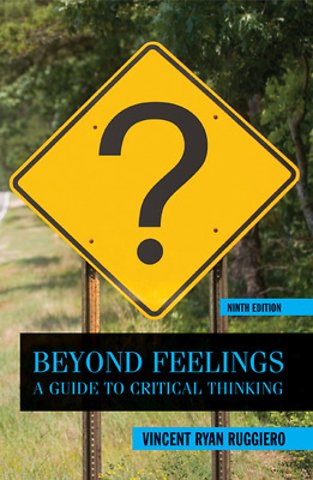
Beyond Feelings: A Guide to Critical Thinking
Specificaties
Paperback, blz.
|
Engels
McGraw-Hill Education |
9e druk, 2011
ISBN13: 9780078038181
Rubricering
Levertijd ongeveer 11 werkdagen
Gratis verzonden
Samenvatting
This succinct, interdisciplinary introduction to critical thinking successfully dares students to question their own assumptions and to enlarge their thinking through the analysis of the most common problems associated with everyday reasoning. The text offers a unique and effective organization: Part I explains the fundamental concepts; Part II describes the most common barriers to critical thinking; Part III offers strategies for overcoming those barriers.
Specificaties
Inhoudsopgave
<H3> Preface <H3> Introduction<H2> PART I. THE CONTEXT <H3> 1. Who Are You?<h4>The Influence of Time and Place<h4>The Influence of Ideas<h4>The Influence of Mass Culture<h4>The "Science" of Manipulation<h4>The Influence of Psychology<h4>Becoming an Individual<H3> 2. What Is Critical Thinking?<h4>Mind, Brain, or Both?<h4>Critical Thinking Defined<h4>Characteristics of Critical Thinkers<h4>The Role of Intuition<h4>The Basic Activities of Critical Thinking<h4>Critical Thinking and Writing<h4>Critical Thinking and Discussion<h4>Avoiding Plagiarism<H3> 3. What Is Truth?<h4>Where Does It All Begin?<h4>Imperfect Perception<h4>Imperfect Memory<h4>Deficient Information<h4>Even the Wisest Can Err<h4>Truth Is Discovered, Not Created<H3> 4. What Does It Mean to Know?<h4>Requirements of Knowing<h4>Testing Your Own Knowledge<h4>How We Come to Know<h4>Why Knowing is Difficult<h4>A Cautionary Tail<h4>Is Faith a Form of Knowledge<h4>Obstacles to Knowledge<H3> 5. How Good Are Your Opinions?<h4>Opinions Can Be Mistaken<h4>Opinions on Moral Issues<h4>Even Experts Can Be Wrong<h4>Kinds of Errors<h4>Informed Versus Uninformed Opinion<h4>Forming Opinions Responsibly<H3> 6. What Is Evidence?<h4>Kinds of Evidence<h4>Evaluating Evidence<h4>What Constitutes "Sufficient" Evidence?<H3> 7. What Is Argument?<h4>The Parts of an Argument<h4>Evaluating Arguments<h4>More Difficult Arguments<H2> PART II. THE PITFALLS<H3> 8. The Basic Problem: "Mine Is Better"<h4>Egocentric People<h4>Ethnocentric People<h4>Controlling "Mine-Is-Better" Thinking<H3> 9. Errors of Perspective<h4>Poverty of Aspect<h4>Unwarranted Assumptions<h4>The Either/Or Outlook<h4>Mindless Conformity<h4>Absolutism<h4>Relativism<h4>Bias For or Against Change<H3> 10. Errors of Procedure<h4>Biased Consideration of Evidence<h4>Double Standard<h4>Hasty Conclusion<h4>Overgeneralization and Stereotyping<h4>Oversimplification<h4>The Post Hoc Fallacy<H3> 11. Errors of Expression<h4>Contradiction<h4>Arguing in a Circle<h4>Meaningless Statement<h4>Mistaken Authority<h4>False Analogy<h4>Irrational Appeal<H3> 12. Errors of Reaction<h4>Automatic Rejection<h4>Changing the Subject<h4>Shifting the Burden of Proof<h4>"Straw Man"<h4>Attacking the Critic<H3> 13. The Errors in Combination<h4>Errors of Perspective<h4>Errors of Procedure<h4>Errors of Expression<h4>Errors of Reaction<h4>Sample Combinations of Errors<h4>A Sensible View of Terminology<H2> PART III. A STRATEGY<H3> 14. Knowing Yourself<h4>Critical Thinking Inventory<h4>Using Your Inventory<h4>Challenge and Reward<H3> 15. Being Observant<h4>Observing People<h4>Observation in Science and Medicine<h4>The Range of Application<h4>Becoming More Observant<h4>Reflecting Your Observations<H3> 16. Selecting an Issue<h4>The Basic Rule: Less Is More<h4>How to Limit an Issue<h4>Sample Issue: Pornography<h4>Sample Issue: Boxing<h4>Sample Issue: Juvenile Crime<h4>Narrowing the Issue Further<H3> 17. Conducting Inquiry<h4>Working with Inconclusive Results<h4>Where to Look for Information<h4>Keeping Focused<h4>How Much Inquiry is Enough?<h4>Managing Lengthy Material<H3> 18. Forming a Judgment<h4>Evaluating Evidence<h4>Evaluating Your Sources' Arguments<h4>Making Important Distinctions<h4>Expressing Judgments<H3> 19. Persuading Others<h4>Guidelines for Persuasion<h4>An Unpersuasive Presentation<h4>A Persuasive Presentation<H3> Notes<H3> Index