Michelle F. Wright,
Lawrence B. Schiamberg
Elsevier Science
e druk, 2020
9780128174999
Child and Adolescent Online Risk Exposure
An Ecological Perspective
Specificaties
Paperback, blz.
|
Engels
Elsevier Science |
2020
ISBN13: 9780128174999
Rubricering
Levertijd ongeveer 9 werkdagen
Gratis verzonden
Samenvatting
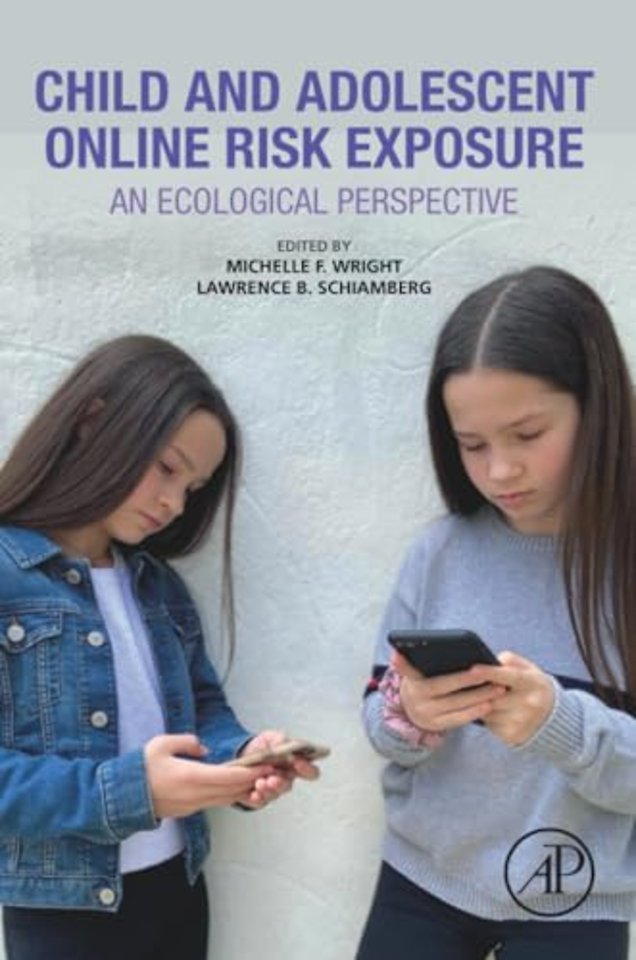
Child and Adolescent Online Risk Exposure: An Ecological Perspective focuses on online risks and outcomes for children and adolescents using an ecological perspective (i.e., the intersection of individuals in relevant contexts) for a better understanding of risks associated with the youth online experience. The book examines the specific consequences of online risks for youth and demonstrates how to develop effective and sensitive interventions and policies. Sections discuss why online risks are important, individual and contextual factors, different types of risk, online risks among special populations, such as LGBT youth, physically or intellectually disabled youth, and ethnic and religious minorities, and intervention efforts.
Specificaties
Inhoudsopgave
<p>Preface</p> <p>Section I: Introduction</p> <p>1. Introduction <br>Lawrence B. Schiamberg and Michelle F. Wright</p> <p>Section II: Types of Online Risks</p> <p>2. Problematic internet use: causes, consequences, and future directions <br>Michelle F. Wright, Tali Heiman and Dorit Olenik-Shemesh</p> <p>3. The process of exploitation and victimization of adolescents in digital environments: the contribution of authenticity and self-exploration <br>John D. Ranney</p> <p>4. Online contact risk behaviors and risk factors among Japanese high school students<br>Ikuko Aoyama</p> <p>5. Understanding child and adolescent cyberbullying<br>Oonagh L. Steer, Peter J.R. Macaulay and Lucy R. Betts</p> <p>6. Online aggression and romantic relationships in adolescence<br>Chelsea Olson and Amy Bellmore</p> <p>7. The longitudinal associations of cyberbullying and cybervictimization: preliminary findings from a two-wave study<br>Fatih Bayraktar and Michelle F. Wright</p> <p>8. The rising threat of cyberhate for young people around the globe<br>Sheri Bauman, Vanessa M. Perry and Sebastian Wachs</p> <p>9. Same incident, different story? Investigating early adolescents’ negative online peer interactions from different perspectives<br>Sara Pabian, Sara Erreygers, Kathleen Van Royen and Heidi Vandebosch</p> <p>Section III: Special Populations and Online Risks</p> <p>10. Parental vigilance, low self-control, and Internet dependency among rural adolescents<br>Magda Javakhishvili and Alexander T. Vazsonyi</p> <p>11. Cyberbullying perpetration and victimization among ethnic minority youth in the United States: similarities or differences across groups?<br>Guadalupe Espinoza and Fardusa Rashid Ismail</p> <p>12. Racial and ethnic diversity in the social ecology of online harassment and cybervictimization: the adolescent school context<br>Gia Elise Barboza and Lawrence B. Schiamberg</p> <p>13. Cyberbullying and cybervictimization among youth with disabilities<br>Morgan A. Eldridge, Michelle L. Kilpatrick Demaray, Jonathan D. Emmons and Logan N. Riffle</p> <p>14. The negative online experiences of maltreated children and adolescents<br>Michelle F. Wright</p> <p>15. LGBTQ youth and digital media: online risks<br>Tyler Hatchel, Cagil Torgal, America J. El Sheikh, Luz E. Robinson, Alberto Valido and Dorothy L. Espelage</p> <p>16. Gendered nature of digital abuse in romantic relationships in adolescence<br>Beatriz VÍllora, Santiago Yubero, Elisa Larrañaga and Raúl Navarro</p> <p>Section IV: Interventions and Policies</p> <p>17. Advances in the cyberbullying literature: theory-based interventions<br>Christopher P. Barlett, Matthew M. Simmers and Luke W. Seyfert</p> <p>18. Online risk interventions: implications of theory of mind and other considerations<br>Tina Montreuil and Hagit Malikin</p> <p>19. Using focus groups and quality circles to enable pupil voice in European teenagers from socioeconomically disadvantaged backgrounds<br>Noel Purdy, Jayne Hamilton, Peter K. Smith, Catherine Culbert, Herbert Scheithauer, Nora Fiedler, Antonella Brighi, Consuelo Mameli, Annalisa Guarini, Damiano Menin, Trijntje Völlink and Roy A. Willems</p> <p>20. Conclusion<br>Michelle F. Wright and Lawrence B. Schiamberg<br></p>