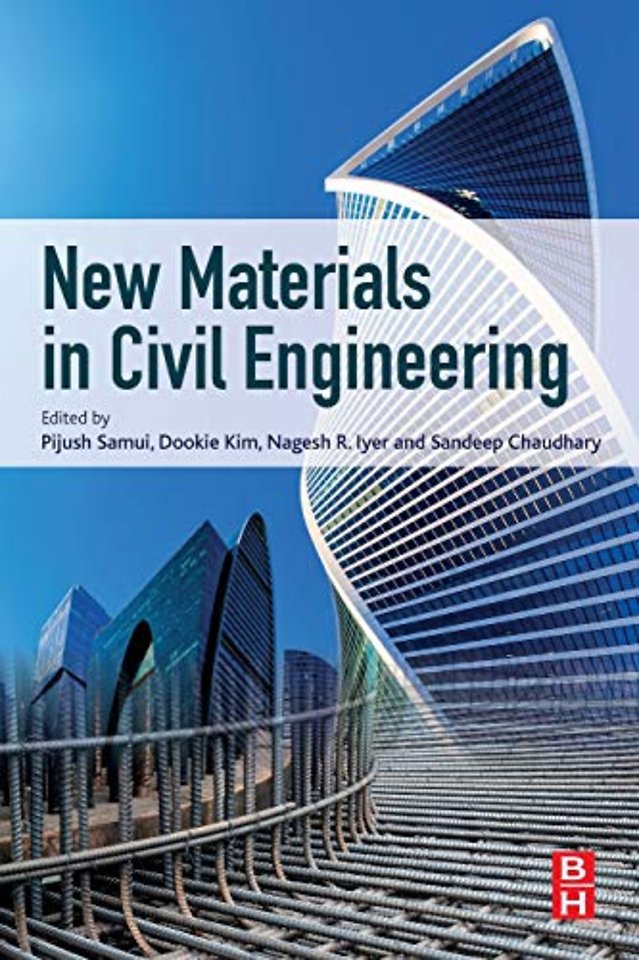
, , , e.a.

New Materials in Civil Engineering

Specificaties
Paperback, blz. | Engels
Elsevier Science | 2020
ISBN13: 9780128189610
Rubricering
Elsevier Science e druk, 2020 9780128189610
€ 279,40
Levertijd ongeveer 9 werkdagen
Gratis verzonden

Samenvatting

New Materials in Civil Engineering provides engineers and scientists with the tools and methods needed to meet the challenge of designing and constructing more resilient and sustainable infrastructures. This book is a valuable guide to the properties, selection criteria, products, applications, lifecycle and recyclability of advanced materials. It presents an A-to-Z approach to all types of materials, highlighting their key performance properties, principal characteristics and applications. Traditional materials covered include concrete, soil, steel, timber, fly ash, geosynthetic, fiber-reinforced concrete, smart materials, carbon fiber and reinforced polymers. In addition, the book covers nanotechnology and biotechnology in the development of new materials.

Specificaties

ISBN13:9780128189610
Taal:Engels
Bindwijze:Paperback

Inhoudsopgave

<p>1. An overview of cementitious construction materials<br>2. Computational intelligence for modeling of pavement surface characteristics<br>3. Computational intelligence for modeling of asphalt pavement surface distress<br>4. Expanded polystyrene geofoam<br>5. Recycling of industrial wastes for value-added applications in clay-based ceramic products: a global review (2015-19)<br>6. Emerging advancement of fiber-reinforced polymer composites in structural applications<br>7. Fiber-reinforced concrete and ultrahigh-performance fiber-reinforced concrete materials<br>8. The superplasticizer effect on the rheological and mechanical properties of self-compacting concrete<br>9. Trends and perspectives in the use of timber and derived products in building facades<br>10. Dynamic response of laminated composite plates fitted with piezoelectric actuators<br>11. Functional nanomaterials and their applications toward smart and green buildings<br>12. Production of sustainable concrete composites comprising waste metalized plastic fibers and palm oil fuel ash<br>13. Alkali-activated concrete systems: a state of art<br>14. Porous concrete pavement containing nanosilica from black rice husk ash<br>15. Porous alkali-activated materials<br>16. Lightweight cement-based materials<br>17. Development of alkali-activated binders from sodium silicate powder produced from industrial wastes<br>18. Innovative cement-based materials for environmental protection and restoration<br>19. Comparative effects of using recycled CFRP and GFRP fibers on fresh- and hardened-state properties of self-compacting concretes: a review<br>20. Corrosion inhibitors for increasing the service life of structures<br>21. Use of fly ash for the development of sustainable construction materials<br>22. An innovative and smart road construction material: thermochromic asphalt binders<br>23. Resin and steel-reinforced resin used as injection materials in bolted connections<br>24. Swelling behavior of expansive soils stabilized with expanded polystyrene geofoam inclusion<br>25. New generation of cement-based composites for civil engineering<br>26. Potential use of recycled aggregate as a self-healing concrete carrier<br>27. Self-healing concrete<br>28. Equations for prediction of rubberized concrete compressive strength: a literature review<br>29. Influence of cobinders on durability and mechanical properties of alkali-activated magnesium aluminosilicate binders from soapstone<br>30. Fly ash utilization in concrete tiles and paver blocks<br>31. Problems in short-fiber composites and analysis of chopped fiber-reinforced materials</p>
€ 279,40
Levertijd ongeveer 9 werkdagen
Gratis verzonden

Rubrieken

    Personen

      Trefwoorden

        New Materials in Civil Engineering