Rosario Moratalla,
Mario Gustavo Murer
Elsevier Science
e druk, 2025
9780443219924
Handbook of Parkinson's Disease Mechanisms
Specificaties
Gebonden, blz.
|
Engels
Elsevier Science |
2025
ISBN13: 9780443219924
Rubricering
Onderdeel van serie
Handbook of Behavioral Neuroscience
Levertijd ongeveer 9 werkdagen
Gratis verzonden
Samenvatting
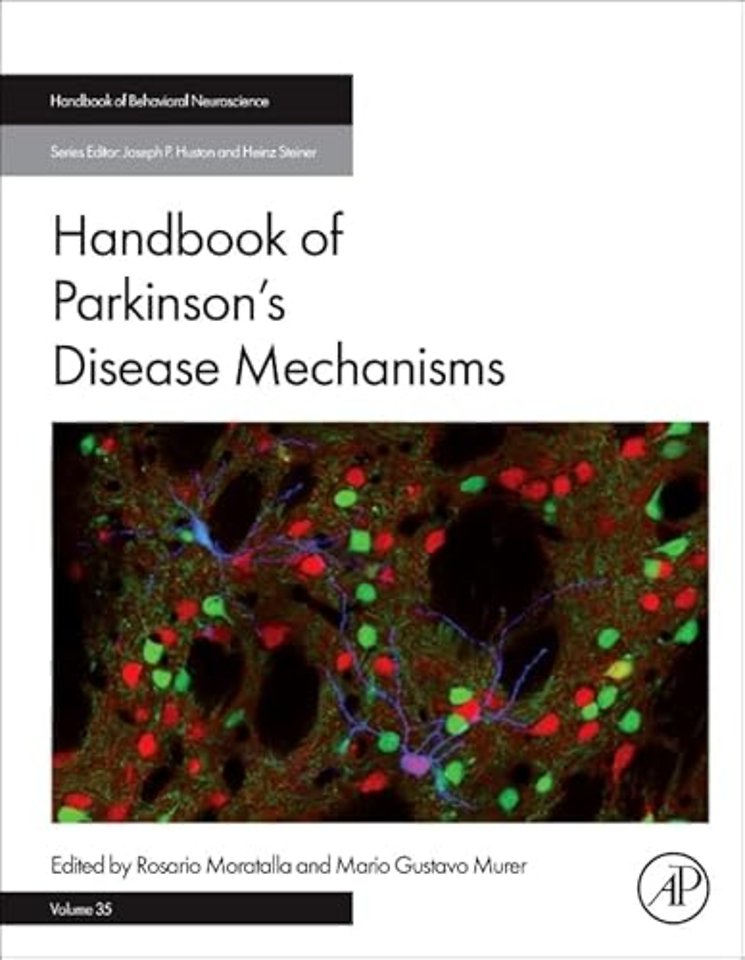
The Handbook of Parkinson’s Disease Mechanisms offers an integrated overview of the fundamental research devoted to understanding its causes and mechanisms, highlighting recent advances and clinical significance. With a strong focus on cellular and animal model studies, this book also examines the etiology, pathophysiology, epidemiology and underlying symptoms of Parkinson’s disease.
Written with an interdisciplinary approach, this book provides thorough research that will be of interest to researchers, clinicians and graduate students interested in neurodegenerative diseases.
Specificaties
Inhoudsopgave
1. Pathology, postmortem studies, neuromelanin<br>2. PD epidemiology and PD economic burden<br>3. Genetic influences and other causes<br>4. Animal models for the study of PD etiology<br>5. New cellular and organoid models for the study of PD<br>6. Lewy bodies, Molecular Interactions of Lewy bodies in the brain<br>7. Synaptophaty in PD; alpha-syn and tau relationship with PD<br>8. Parkinson's disease as a synucleinopathy<br>9. Lysosomal function and protein aggregation in PD<br>10. Autophagy and mitophagy and neuropathological markers of familiar PD<br>11. Mitochondrial dysfunction in PD<br>12. The gut brain axis in PD<br>13. Dopaminergic neurons susceptibility to degeneration / dysfunction of mitochondria, new PD models<br>14. Neuroinflammation and microglia<br>15. Extracellular space modifications and PD<br>16. Dopamine neurotransmission in Parkinson’s Disease<br>17. Dopamine effects in striatal and subthalamic nucleus neurons<br>18. Adaptations that follow partial and severe striatal dopaminergic denervation<br>19. Molecular mechanisms underlying L-DOPA-induced dyskinesia, role of dopamine receptors<br>20. Imaging and electrophysiology of direct and indirect pathway neurons in freely moving animals<br>21. Striatal cholinergic system in PD<br>22. Striatal serotoninergic system in PD<br>23. Opto and chemogenetic studies on L-DOPA-induced dyskinesia<br>24. Network dynamics in rodent PD and LID models<br>25. Network dynamics in primate models and patients ; effects of DBS on network dynamics<br>26. Mechanisms underlying impulse control disorders in PD<br>27. Brain stem mechanism of PD symptoms