,

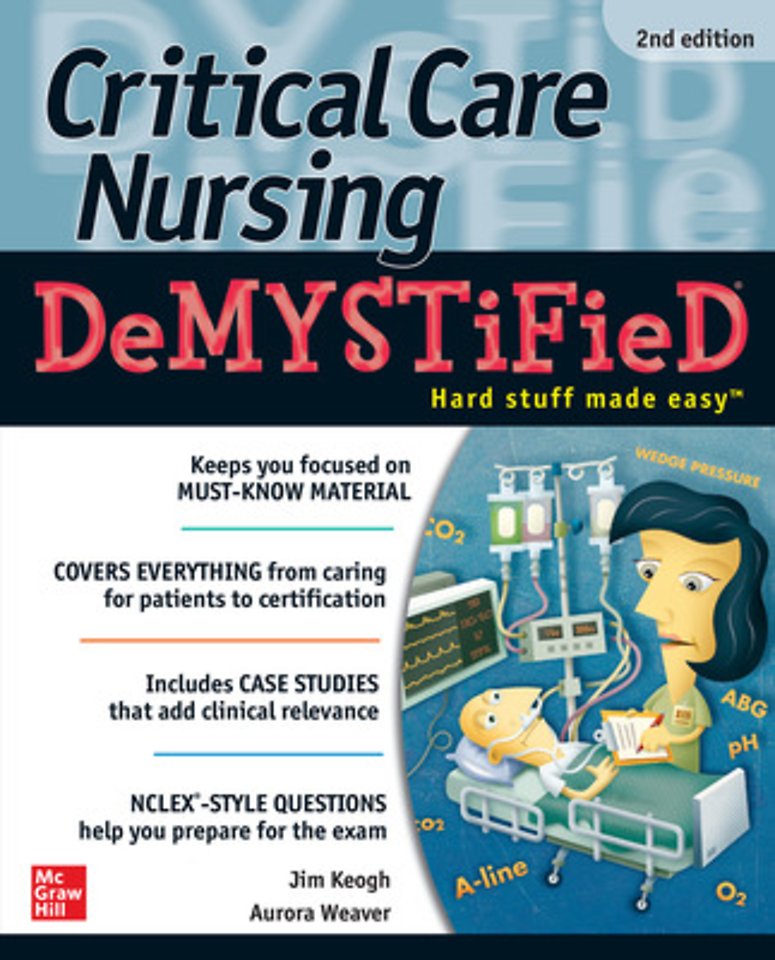
Critical Care Nursing DeMYSTiFieD, Second Edition

Specificaties
Paperback, blz. | Engels
McGraw-Hill Education | 2e druk, 2021
ISBN13: 9781260440874
Rubricering
McGraw-Hill Education 2e druk, 2021 9781260440874
€ 46,00
Levertijd ongeveer 11 werkdagen
Gratis verzonden

Samenvatting

A fun, streamlined way to learn the major concepts and theories of critical care nursing – and how to apply them to real-world patient situations

Valuable to professional nurses who wants to transition into critical care nursing or students seeking to excel in their advanced studies, Critical Care Nursing Demystified, Second Edition is the book they need to quickly and easily understand the key concepts and advanced trends of this specialty.

In order to make the learning process as quick and effective as possible, each chapter contains lesson objectives, key terms, NCLEX®-style Q&A, and vignettes of nursing situations you are likely to encounter in the workplace. You will also find a comprehensive final exam and coverage that includes overviews of basic anatomy and physiology of target organ systems, detailed health assessments using the body systems approach, diagnostic studies utilized to confirm an illness, common critical procedures performed, current medications used in the treatment of the critical care patient, and implementation of the nursing process to identify and solve patient concerns.

Simple enough for students but challenging enough for professional nurses considering a switch from their current field to this specialty, Critical Care Nursing Demystified is the book you need to make your transition or entry into the field as smooth and painless as possible.

Specificaties

ISBN13:9781260440874
Taal:Engels
Bindwijze:paperback
Druk:2

Inhoudsopgave

<p><B><span>CHAPTER 1 The Critical Care Nurse </SPAN></B></P><p><span>Introduction </SPAN></P><p><span>Education and Experience </SPAN></P><p><span>Standards, Organizations, and Certification:</SPAN></P><p><span>Promoting Excellence </SPAN></P><p><span>Communication and Health Care Team Members:</SPAN></P><p><span>Calling the Shots </SPAN></P><p><span>Defining the Critical Care Nurse </SPAN></P><p><span>Regulatory Issues That Impact the Critical Care</SPAN></P><p><span>Environment </SPAN></P><p><span>Future Challenges for the Critical Care Nurse </SPAN></P><p><span>Review Questions </SPAN></P><p><span>Answers </SPAN></P><p></P><p><B><span>CHAPTER 2 Care of the Patient With Critical Respiratory Needs </SPAN></B></P><p><span>Anatomy and Physiology </SPAN></P><p><span>Assessment Skills for the High-Risk Respiratory</SPAN></P><p><span>Patient </SPAN></P><p><span>Collaborative Diagnostic Tools </SPAN></P><p><span>Oxygen Delivery Systems </SPAN></P><p><span>Advanced Airway Techniques </SPAN></P><p><span>What Is Mechanical Ventilation </SPAN></P><p><span>Commonly Used Respiratory Medications in</SPAN></P><p><span>Critical Care for the Patient on MV </SPAN></P><p><span>Respiratory Conditions Requiring Critical Care </SPAN></P><p><span>Review Questions </SPAN></P><p><span>Answers </SPAN></P><p><B><span>CHAPTER 3 Care of the Patient With Critical Cardiac and Vascular Needs </SPAN></B></P><p><span>Anatomy and Physiology of the Cardiovascular System </SPAN></P><p><span>Assessment Skills </SPAN></P><p><span>Collaborative Diagnostic and Laboratory Tools </SPAN></P><p><span>Advanced Procedural Skills </SPAN></P><p><span>Cardiovascular Medications Used in Critical Care </SPAN></P><p><span>Medical CV Conditions Requiring Critical Care </SPAN></P><p><span>Surgical CV Conditions Requiring Critical Care </SPAN></P><p><span>Review Questions </SPAN></P><p><span>Answers </SPAN></P><p></P><p><B><span>CHAPTER 4 Care of the Patient With Critical Cardiac Rhythm Disturbance Needs </SPAN></B></P><p><span>Assessment Skills </SPAN></P><p><span>Cardiac Electrophysiology </SPAN></P><p><span>How Does Cardiac Monitoring Really Work? </SPAN></P><p><span>So What Do These Systems “See”? </SPAN></P><p><span>So How Does a Nurse Do Detective Work on</SPAN></P><p><span>These Rhythm Strips? </SPAN></P><p><span>Types of Basic Rhythms </SPAN></P><p><span>Where Do 12-Lead ECGs Enter the Picture? </SPAN></P><p><span>Medications That Help With Rhythm Stabilization </SPAN></P><p><span>Special Cardiac Devices to Help Maintain the</SPAN></P><p><span>Patient’s Rhythm </SPAN></P><p><span>Cardiac Arrest: Your Worst Nightmare </SPAN></P><p><span>Review Questions </SPAN></P><p><span>Answers </SPAN></P><p></P><p><B><span>CHAPTER 5 Care of the Patient With Neurological Needs </SPAN></B></P><p><span>Introduction </SPAN></P><p><span>Anatomy and Physiology of the Nervous System </SPAN></P><p><span>Neurological Needs: Assessment </SPAN></P><p><span>Assessing Motor Movements—Strength and</SPAN></P><p><span>Coordination </SPAN></P><p><span>Normal Pupils </SPAN></P><p><span>Assessment of Eye Movements (EOMs) or</SPAN></P><p><span>Extraocular Movements </SPAN></P><p><span>Oculocephalic Reflex or Doll’s Eyes Movements </SPAN></P><p><span>Oculovestibular Reflex or Cold Caloric Test </SPAN></P><p><span>Respiratory Patterns </SPAN></P><p><span>Additional Assessments </SPAN></P><p><span>Palpation </SPAN></P><p><span>Percussion—Deep Tendon Reflexes </SPAN></P><p><span>Other Responses <BR>Auscultation <BR>Collaborative Diagnostic Tools <BR>Medications That Help With Symptoms <BR>Medical Conditions Requiring Complex Care <BR>Surgical Conditions Requiring Complex<BR>Neurological Care <BR>Review Questions <BR>Answers </SPAN></P><p><B><span>CHAPTER 6 Care of the Traumatized Patient </SPAN></B></P><p><span>Introduction </SPAN></P><p><span>Mechanisms of Injury (MOI) </SPAN></P><p><span>Classification of Injuries </SPAN></P><p><span>Evaluating Reports from the Field </SPAN></P><p><span>Trauma Center Levels and Classifications </SPAN></P><p><span>Medications Used in Trauma Care </SPAN></P><p><span>Fluid Volume Replacement (FVR) </SPAN></P><p><span>Care of the Patient With Specific Traumatic Injuries</SPAN></P><p><span>According to the ABCs of Trauma Assessment </SPAN></P><p><span>Review Questions </SPAN></P><p><span>Answers </SPAN></P><p></P><p><B><span>CHAPTER 7 Care of the Patient With Endocrine Disorders </SPAN></B></P><p><span>Introduction </SPAN></P><p><span>Major Organs of the Endocrine System to Be</SPAN></P><p><span>Addressed </SPAN></P><p><span>Review Questions </SPAN></P><p><span>Answers </SPAN></P><p></P><p><B><span>CHAPTER 8 Care of the Patient With Critical Renal Needs </SPAN></B></P><p><span>Anatomy and Physiology of the Renal System </SPAN></P><p><span>Assessment Skills </SPAN></P><p><span>Collaborative Diagnostic and Laboratory Tools </SPAN></P><p><span>Medications Commonly Used in Critical Care </SPAN></P><p><span>Dialysis </SPAN></P><p><span>Acute and Chronic Renal Failure </SPAN></P><p><span>Review Questions </SPAN></P><p><span>Answers </SPAN></P><p></P><p><B><span>CHAPTER 9 Care of the Patient With Critical Hematologic Needs </SPAN></B></P><p><span>Anatomy and Physiology of the Hematologic</SPAN></P><p><span>System </SPAN></P><p><span>Assessment Skills </SPAN></P><p><span>Collaborative Diagnostic and Laboratory Tools <BR>Medications Commonly Used in Critical Care That</SPAN></P><p><span>Affect the Hematologic System </SPAN></P><p><span>Blood Products Used for Hematologic Problems </SPAN></P><p><span>Medical Conditions That Require Critical Care </SPAN></P><p><span>Review Questions </SPAN></P><p><span>Answers </SPAN></P><p><I><span>Final Exam Questions </SPAN></I></P><p><I><span>Correct Answers and Rationales </SPAN></I></P><p><I><span>Index </SPAN></I></P>
€ 46,00
Levertijd ongeveer 11 werkdagen
Gratis verzonden

Rubrieken

    Personen

      Trefwoorden

        Critical Care Nursing DeMYSTiFieD, Second Edition