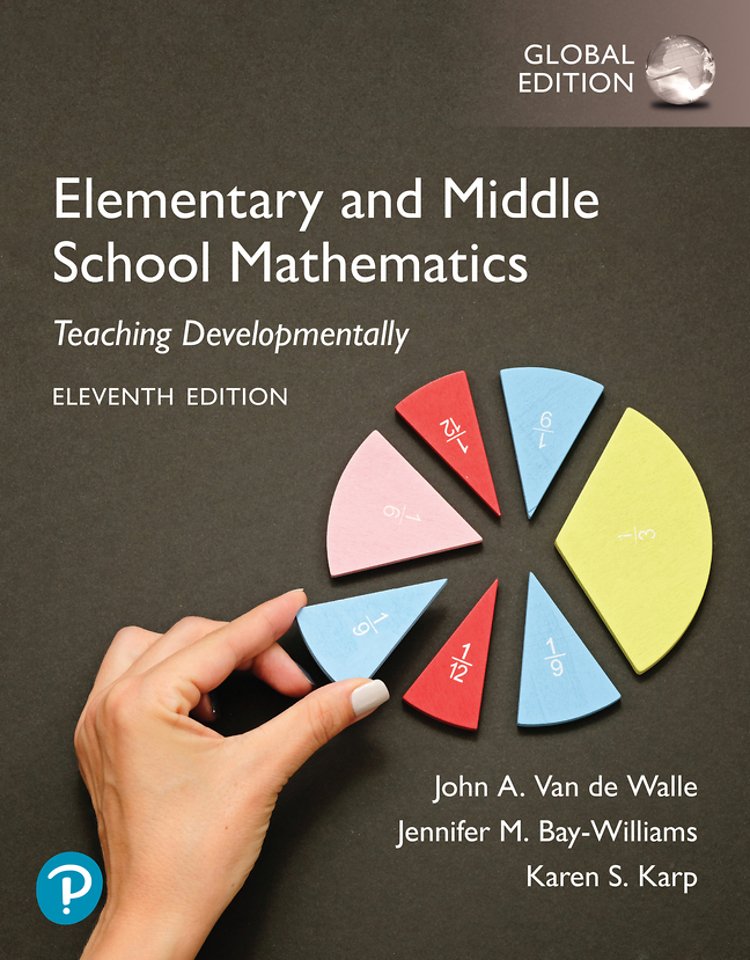
Elementary and Middle School Mathematics: Teaching Developmentally, Global Edition
Samenvatting
For courses in teaching math methods (preK-8).
Guide teachers to help all PreK to 8th grade learners make sense of math Elementary and Middle School Mathematics illustrates how children in PreK to 8th grade learn math, and then supplies concrete, effective methods of teaching math using problem-based activities. Examples of real student work, common challenges, and hundreds of classroom-ready hands-on tasks help readers visualize developmentally appropriate mathematics instruction and assessment that supports and challenges all learners.
The 11th Edition, Global Edition, reflects the Common Core State Standards and NCTM's Principles to Actions, as well as current research and the latest teaching technology.
Hallmark features of this title
-Samples of real student work show children's mathematical reasoning in context.
-Adaptations to Challenge and Support Students offer practical strategies to make activities accessible to all students.
-Formative Assessment Notes help educators evaluate students' understanding of content areas and offer the best methods to assist struggling students.
-Common Challenges tables outline a student challenge and what it looks like, with tips on how to help.
-Big Ideas lists help readers envision how to form their lesson plans around major themes rather than isolated skills or concepts.
-Research-based strategies, NCTM Teaching Standards, and Standards for Mathematical Practice Margin Notes provide a thorough reference for all of the math content suggested for grades PreK-8.
New and updated features of this title Classroom-ready strategies
-UPDATED: Hundreds of problem-based activities model specific ways to engage students in doing mathematics. This edition includes more than 40 new activities.
-UPDATED: Teaching reasoning strategies in basic facts, whole numbers and fractions is covered in more depth in Chs. 9, 11, 12 and 15.
-UPDATED: Technology Notes reference new open-source software, apps and digital resources to use in teaching. Literature Connections list fun ways to use children's books to teach math, including 2 new lists for different reading levels on measurement and geometry.
Learner-focused content
-NEW: Learning Progressions in each chapter offer guidance for planning units, understanding prior knowledge and future directions, and informing assessment development.
-NEW: Writing to Learn exercises ask readers to analyze and reflect on each chapter's big ideas. The exercises can be assigned or used to spark discussions in class.
Specificaties
Inhoudsopgave
-Teaching to Build Confident and Competent Mathematics Learners
-Exploring What It Means to Know and Do Mathematics
-Teaching Problem-based Mathematics
-Planning in the Problem-Based Classroom
-Creating Assessments for Learning
-Teaching Mathematics Equitably to All Students
PART II: Teaching Mathematics Developmentally: Concepts and Procedures in PreK-8
-Developing Early Number Concepts and Number Sense
-Developing Meanings for the Operations
-Developing Basic Fact Fluency
-Developing Whole-Number Place-Value Concepts
-Developing Strategies for Addition and Subtraction Computation
-Developing Strategies for Multiplication and Division Computation
-Algebraic Thinking
-Developing Fraction Concepts
-Developing Fraction Operations
-Developing Decimal and Percent Concepts and Decimal Computation
-Ratios and Proportional Reasoning
-Developing Measurement Concepts
-Developing Geometric Thinking and Geometric Concepts
-Developing Concepts of Data and Statistics
-Exploring Concepts of Probability
-Developing Concepts of Exponents, Negative Numbers, and Real Numbers
APPENDICES
-Standards for Mathematical Practice
-NCTM Mathematics Teaching Practices from Principles to Actions
-Guide to Blackline Masters
-Activities at a Glance