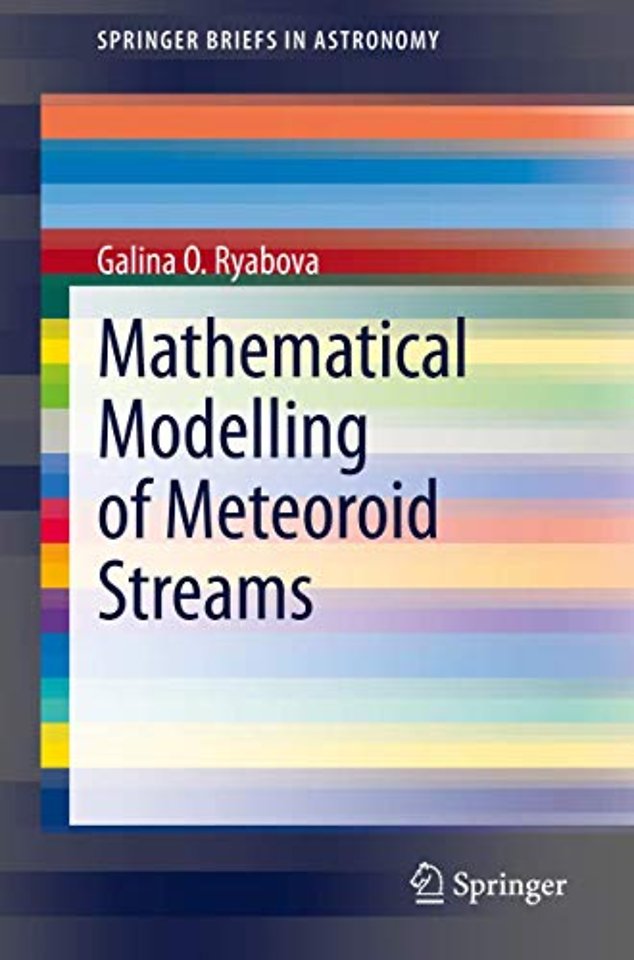
Mathematical Modelling of Meteoroid Streams

Specificaties
Paperback, blz. | Engels
Springer International Publishing | 2020
ISBN13: 9783030515096
Rubricering
Springer International Publishing e druk, 2020 9783030515096
Onderdeel van serie SpringerBriefs in Astronomy
€ 60,99
Levertijd ongeveer 9 werkdagen
Gratis verzonden

Samenvatting

Modern computer power and high-precision observational data have greatly improved the reliability of meteoroid stream models. At present, scientific research calls for two kinds of models: precise ones for individual streams, and statistically averaged ones for Solar System dust distribution models. Thus, there is a wide field of study open to stream modellers.

This brief describes step-by-step computer simulations of meteoroid stream formation and evolution. Detailed derivations of relevant formulae are given, along with plenty of helpful, digestible figures explaining the subtleties of the method. Each theoretical section ends with examples aimed to help readers practice and master the material.

Most of the examples are based on the Geminid meteoroid stream model, which has been developed by the author in the last 30 years. The book is intended for researchers interested in meteor astronomy and mathematical modelling, and it is also accessible to physics and astrophysics students.

Specificaties

ISBN13:9783030515096
Taal:Engels
Bindwijze:paperback
Uitgever:Springer International Publishing

Inhoudsopgave

Preface<div>1. Introduction</div><div>1.1 Mathematical modelling in general</div><div>1.2 On history of meteoroid stream modelling</div><div>2. Initial stage: the model stream generation</div><div>2.1 Choice of the ejection point on the reference orbit</div><div>2.1.1 Ejection in one point</div><div>2.1.2 Ejection along the orbit</div><div>2.2 Ejection velocity vector</div><div>2.2.1 Coordinate system</div><div>2.2.2 Isotropic ejection</div><div>2.2.3 Ejection in a cone</div><div>2.2.4 Subsolar point and the cosine ejection</div><div>2.2.5 Ejection speed</div><div>2.3 Calculation of the model meteoroid orbit</div><div>2.4 A simple model: the nonperturbed stream</div><div>3. The model stream evolution</div><div>3.1 Numerical integration</div><div>3.2 Analytical solution</div><div>3.3 How to take into account the radiation pressure force</div><div>3.4 How to take into account the Poynting–Robertson drag force</div><div>4. The end stage: the model stream now</div><div>4.1 Meteoroids registration on the Earth</div><div>4.2 The activity profile of the model meteor shower</div><div>4.3 Model radiants</div><div>4.4 Mass distribution in the model shower</div><div>5. Visualization of the results</div><div>5.1 Cross‐section in the ecliptic plane</div><div>5.2 Cross‐section perpendicular to the velocity vector</div><div>6. Application to real streams, analysis</div><div>6.1 Physical model of a meteoroid stream</div><div>6.2 Age of a meteoroid stream</div><div>6.3 Observations — the base for modelling</div><div>Notation conventions</div><div>Glossary</div><div>References</div><div>APPENDICES</div><div>A1. Transition from the rectangular coordinates to the orbital elements and back</div><div>A2. Transition between the coordinate systems</div><div>A3. Random number generation</div>
€ 60,99
Levertijd ongeveer 9 werkdagen
Gratis verzonden

Rubrieken

    Personen

      Trefwoorden

        Mathematical Modelling of Meteoroid Streams