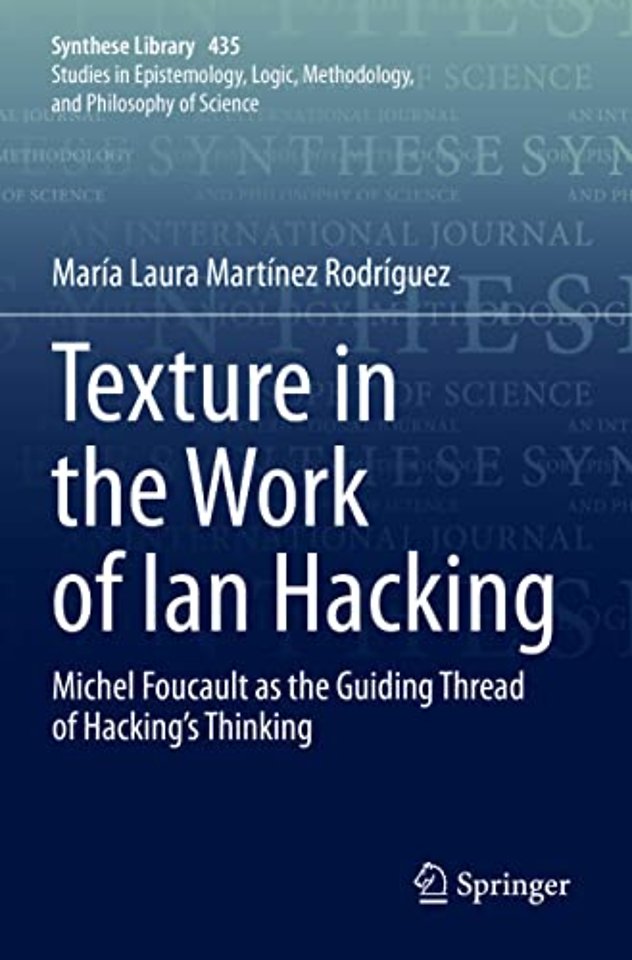
,

Texture in the Work of Ian Hacking

Michel Foucault as the Guiding Thread of Hacking’s Thinking

Specificaties
Paperback, blz. | Engels
Springer International Publishing | 2022
ISBN13: 9783030647872
Rubricering
Springer International Publishing e druk, 2022 9783030647872
Onderdeel van serie Synthese Library
€ 102,99
Levertijd ongeveer 9 werkdagen
Gratis verzonden

Samenvatting

This book offers a systematized overview of Ian Hacking's work. It presents Hacking’s oeuvre as a network made up of four interconnected key nodes: styles of scientific thinking & doing, probability, making up people, and experimentation and scientific realism.

Its central claim is that Michel Foucault’s influence is the underlying thread that runs across the Canadian philosopher’s oeuvre. Foucault’s imprint on Hacking’s work is usually mentioned in relation to styles of scientific reasoning and the human sciences. This research shows that Foucault’s influence can in fact be extended beyond these fields, insofar the underlying interest to the whole corpus of Hacking’s works, namely the analysis of conditions of possibility, is stimulated by the work of the French philosopher.

Displacing scientific realism as the central focus of Ian Hacking’s oeuvre opens up a very different landscape, showing, behind the apparent dispersion of his works, the far-reaching interest that amalgamates them: to reveal the historical and situated conditions of possibility for the emergence of scientific objects and concepts.

This book shows how Hacking’s deployment concepts such as looping effect, making up people, and interactive kinds, can complement Foucauldian analyses, offering an overarching perspective that can provide a better explanation of the objects of the human sciences and their behaviors.

Specificaties

ISBN13:9783030647872
Taal:Engels
Bindwijze:paperback
Uitgever:Springer International Publishing

Inhoudsopgave

Acknowledgments<div>Contents</div><div>Introduction</div><div><br></div><div>Chapter 1. “Taking a look” at Ian Hacking’s work</div><div>1. The nodes of the network</div><div>1.1 Scientific reasoning or thinking & doing style</div><div>1.2 Probability</div><div>1.3 Making up people</div><div>1.4 Experimentation and scientific realism</div><div>2. Constructing the network</div><div><br></div><div>Chapter 2. Styles of scientific thinking & doing. A genealogy of scientific reason</div><div>1. Antecedents of style of reasoning or style of scientific thinking & doing</div><div>2. Metaphysics, microsociology and anthropology</div><div>3. Anonymous, autonomous and common to several sciences</div><div>4. The relation style-ontology</div><div>5. Stabilization techniques</div><div>6. Style and positivity</div><div>7. Style and truth</div><div>8. An innovation with respect to Crombie: the idea of crystallization</div><div>9. Practical incommensurability</div><div>10. Essence of the style: classification</div><div><br></div><div>Chapter 3. Probability. Books that smell like other books</div><div>1. The Emergence of Probability (1975)</div><div>1.1 Archaeology in The Emergence of Probability</div><div>1.2 The emergence of probability</div><div>1.3 The Emergence of Probability, an example of historical meta-epistemology</div><div>2. The Taming of Chance (1990)</div><div>2.1 Words in their sites</div><div>2.2 The erosion of determinism and the emergence of chance</div><div>2.3 Genealogy in The Taming of Chance</div><div><br></div><div>Chapter 4. Making up people. A project of more than three decades</div><div>1. Are there natural kinds?</div><div>2. Dynamic nominalism</div><div>3. Historical ontology</div><div>4. Contingentism</div><div>5. Making up people and looping effect</div><div>6. Looping effect and memory</div><div>7. Metaphor of the ecological niche</div><div>8. Different types of kinds</div><div>9. Kinds of people</div><div><br></div><div>Chapter 5. Classifications, looping effect and power</div><div>1. An overview of power in Foucault</div><div>2. Classification, looping effect and power</div><div>3. Classifications, looping effect and resistance</div><div><br></div><div>Chapter 6. Experimentation and Scientific Realism. A return of Francis Bacon</div><div>1. Experimentation and Scientific Realism</div><div>2. The realism/antirealism debate</div><div>3. Entity realism</div><div>4. Creation of phenomena</div><div>5. “Saving phenomena”?</div>6. Representing and intervening in the natural and human sciences<div><br></div><div>Chapter 7. On Foucault’s shoulders</div><div>1. Scientific realism in Hacking’s work viewed as a whole</div><div>2. The analysis of conditions of possibility as the main interest of Hacking’s work</div><div>3. Michael Foucault: the texture in Hacking’s work</div><div><br></div><div>Epilogue</div><div>References </div><div>Index</div>
€ 102,99
Levertijd ongeveer 9 werkdagen
Gratis verzonden

Rubrieken

    Personen

      Trefwoorden

        Texture in the Work of Ian Hacking