, , , , e.a.

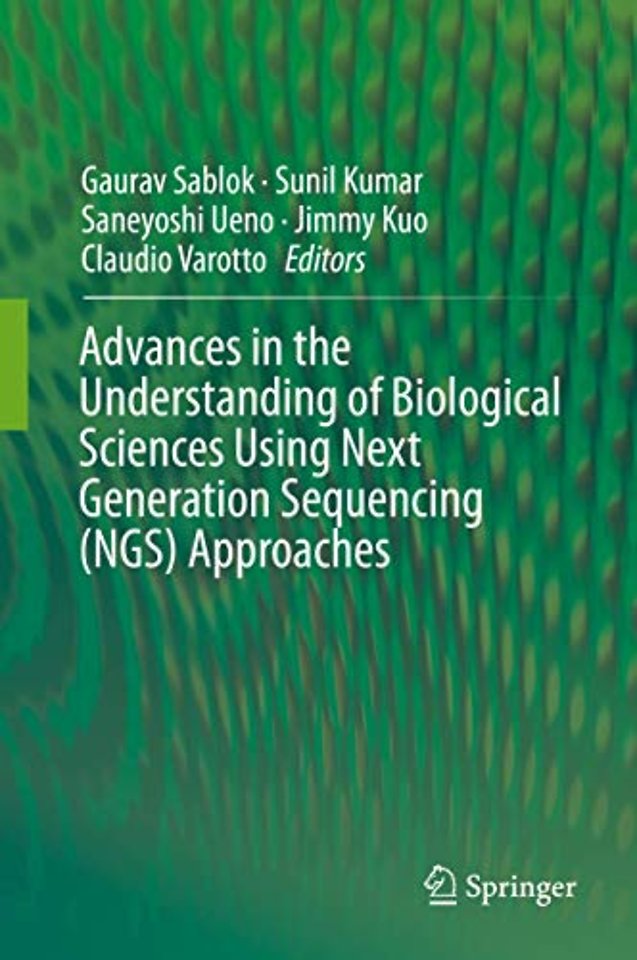
Advances in the Understanding of Biological Sciences Using Next Generation Sequencing (NGS) Approaches

Specificaties
Gebonden, blz. | Engels
Springer International Publishing | 2015
ISBN13: 9783319171562
Rubricering
Springer International Publishing e druk, 2015 9783319171562
€ 120,99
Levertijd ongeveer 9 werkdagen
Gratis verzonden

Samenvatting

Provides a global view of the recent advances in the biological sciences and the adaption of the pathogen to the host plants revealed using NGS. Molecular Omic’s is now a major driving force to learn the adaption genetics and a great challenge to the scientific community, which can be resolved through the application of the NGS technologies. The availability of complete genome sequences, the respective model species for dicot and monocot plant groups, presents a global opportunity to delineate the identification, function and the expression of the genes, to develop new tools for the identification of the new genes and pathway identification. Genome-wide research tools, resources and approaches such as data mining for structural similarities, gene expression profiling at the DNA and RNA level with rapid increase in available genome sequencing efforts, expressed sequence tags (ESTs), RNA-seq, gene expression profiling, induced deletion mutants and insertional mutants, and gene expression knock-down (gene silencing) studies with RNAi and microRNAs have become integral parts of plant molecular omic’s. Molecular diversity and mutational approaches present the first line of approach to unravel the genetic and molecular basis for several traits, QTL related to disease resistance, which includes host approaches to combat the pathogens and to understand the adaptation of the pathogen to the plant host. Using NGS technologies, understanding of adaptation genetics towards stress tolerance has been correlated to the epigenetics. Naturally occurring allelic variations, genome shuffling and variations induced by chemical or radiation mutagenesis are also being used in functional genomics to elucidate the pathway for the pathogen and stress tolerance and is widely illustrated in demonstrating the identification of the genes responsible for tolerance in plants, bacterial and fungal species.

Specificaties

ISBN13:9783319171562
Taal:Engels
Bindwijze:gebonden
Uitgever:Springer International Publishing

Inhoudsopgave

<p>Ch. 1: Expression analysis and genome annotations with RNA sequencing</p><p> </p><p>            Masaaki Kobayashi, Hajime Ohyanagi, Kentaro Yano</p><p> </p><p>Ch. 2: The application of Next Generation Sequencing techniques to Plant </p><p>Epigenomics</p><p> </p><p>            Manu J. Dubin</p><p> </p><p>Ch. 3: Whole genome sequencing to identify genes and QTL in rice</p><p> </p><p>Ryohei Terauchi, Akira Abe, Hiroki Takagi, Muluneh Tamiru, Rym Fekih, Satoshi Natsume, Hiroki Yaegashi, Shunichi Kosugi, Hiroyuki Kanzaki, Hideo Matsumura, Hiromasa Saitoh, Kentaro Yoshida, Liliana Cano, Sophien Kamoun</p><p> </p><p>Ch. 4: Variant calling using NGS data in European aspen (Populus tremula)</p><p> </p><p>Jing Wang, Douglas Scofield, Nathaniel R. Street, Pär K. Ingvarsson</p><p> </p><p>Ch. 5: Leafy Spurge Genomics: A Model Perennial Weed To </p><p>Investigate Development, Stress Responses, And Invasiveness</p><p> </p><p>David Horvath, James Anderson, Wun Chao, Michael Foley, Münevver Doğramaci  </p><p> </p><p>Ch. 6: Utilization of NGS and proteomic-based approaches to gain insights on </p><p>cellular responses to singlet oxygen and improve energy yields for bacterial stress adaptation</p><p> </p><p>Roger Greenwell, Mobashar Hussain Urf Turabe Fazil, H P Pandey.</p><p> </p><p>Ch. 7: Experimental evolution and next generation sequencing illuminate the </p><p>evolutionary trajectories of microbes</p><p> </p><p>Mario Fares</p><p> </p><p> </p><p> </p><p> </p><p>Ch. 8: Plant carbohydrate active enzyme (CAZyme) repertoires: a comparative </p><p>Study</p><p> </p><p>Huansheng Cao, Alex Ekstrom, Yanbin Yin</p><p> </p><p>Ch. 9: Metagenomics of Plant- Microbe Interactions</p><p> </p><p>Riccardo Rosselli, Andrea Squartini</p><p> </p><p>            Ch. 10: Genes and trans-factors underlying embryogenic transition in plant </p><p>soma-cells</p><p> </p><p>Dhananjay K. Pandey, Bhupendra Chaudhary</p><p> </p><p> </p><p>            Ch. 11: Bioinformatics tools to analyze the proteome and genome data</p><p> </p><p>                        Ritesh Kumar, Shalini Singh, Vikash Kumar Dubey</p><p> </p><p> </p><p>            Ch. 12: High through-put transcriptome analysis of plant stress responses</p><p> </p><p>                        Hüseyin Tombuloğlu, Güzin Tombuloğlu</p><p> </p><p>            </p><p>            Ch. 13: CNV and structural variation in plants: prospects of NGS </p><p>                      Approaches</p><p> </p><p>                      Enrico Francia, Nicola Pecchioni, Alberto Policriti, Simone Scalabrin</p>
€ 120,99
Levertijd ongeveer 9 werkdagen
Gratis verzonden

Rubrieken

    Personen

      Trefwoorden

        Advances in the Understanding of Biological Sciences Using Next Generation Sequencing (NGS) Approaches