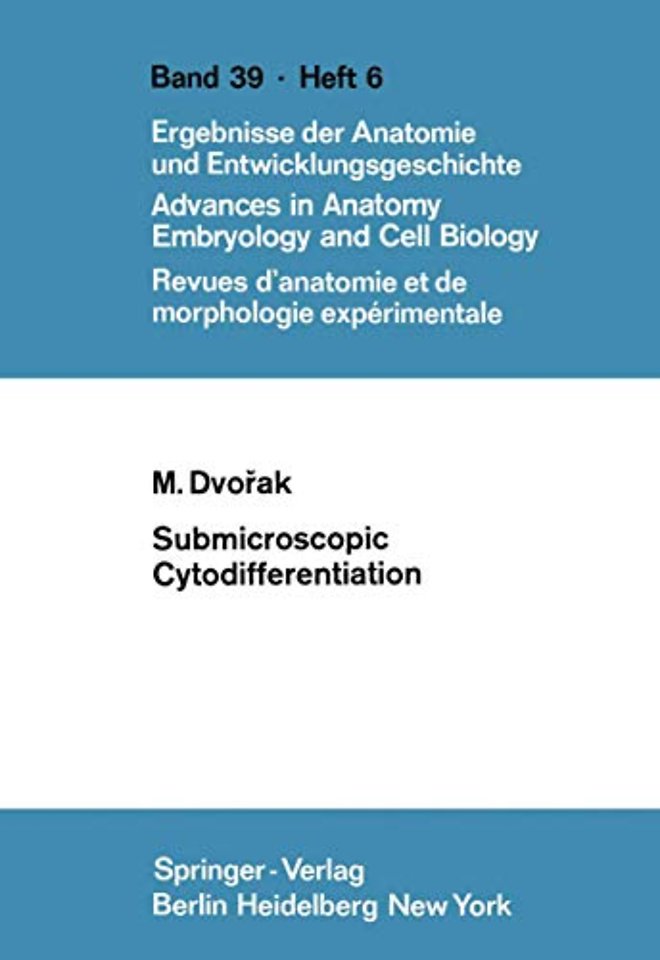
Submicroscopic Cytodifferentiation

Specificaties
Paperback, 118 blz. | Engels
Springer Berlin Heidelberg | 1971
ISBN13: 9783540056225
Rubricering
Springer Berlin Heidelberg e druk, 1971 9783540056225
€ 122,99
Levertijd ongeveer 9 werkdagen
Gratis verzonden

Samenvatting

The progressive changes which occur during the life history of an individual metazoon are summed up under the term development. The adult multicellular organism differs from its early developmental stages by its size, shape, proportions, and by its parts having gradually acquired different structural and functional properties. Accordingly, several main processes involved in development, whose classification is a matter of convention, may be delimitated. Differentiation is considered one of the most important of them. In the broader sense of the word, the term differentiation is used for describing transformations, through which heterogeneity-at all levels (macroscopic, microscopic, submicroscopic)-arises or increases. The basic component of the wider phenomenon of differentiation is differentiation of cells, so-called cytodifferentiation. What is cytodifferentiation? In the course of ontogeny, the cells, starting with the fertilized ovum, via the blastomeres of the segmenting ovum and the germ layer cells, right to the differentiating and fully differentiated cells of tissues and organs, gradually acquire new properties which make them different both from a morphological and functional point of view. All changes involved in this process come under the term cytodifferentiation. Differentiation of cells (though not of all kinds of cells) continues throughout the entire life of the individual, but reaches its maximum at the embryonic period when it becomes the chief feature of development.

Specificaties

ISBN13:9783540056225
Taal:Engels
Bindwijze:paperback
Aantal pagina's:118
Uitgever:Springer Berlin Heidelberg

Inhoudsopgave

I. Introduction.- II. Examples of Submicroscopic Differentiation of Somatic Cells.- A. Differentiation of Rat Ovum during Cleavage.- 1. The Nucleus.- 2. The Cytoplasm.- 3. The Main Features of Submicroscopic Differentiation of the Segmenting Ovum.- B. Differentiation of Liver Cell.- 1. The Nucleus.- 2. The Cytoplasm.- 3. The Main Features of Submicroscopic Differentiation of Liver Cells.- C. Differentiation of Exocrine Cells of the Pancreas.- 1. The Nucleus.- 2. The Cytoplasm.- 3. The Acino-Insular Cells.- 4. The Main Features of Submicroscopic Differentiation of Exocrine Cells of Pancreas at the Perinatal Period.- D. Differentiation of Erythrocytes.- 1. The Mesenchymal Cell.- 2. The Proerythroblast.- 3. The Erythroblasts.- 4. The Reticulocyte and the Erythrocyte.- 5. The Main Features of Submicroscopic Differentiation of Erythrocyte.- III. General Features of Submicroscopic Cytodifferentiation.- A. Basic Types of Submicroscopic Cytodifferentiation.- 1. Cytodifferentiation Characterized by the Submicroscopic Structure Becoming Increasingly Variform.- 2. Cytodifferentiation Characterized by the Submicroscopic Structure Becoming Simpler.- B. General Features of Submicroscopic Differentiation of Nucleus and Cytoplasm.- 1. Differentiation of Nucleus.- 2. Differentiation of Cytoplasm.- a) Changes in Cell Organelles.- b) Origin of Cell Organelles.- C. Cytodifferentiation from a Qualitative and Quantitative Point of View.- IV. Concluding Remarks.- References.
€ 122,99
Levertijd ongeveer 9 werkdagen
Gratis verzonden

Rubrieken

    Personen

      Trefwoorden

        Submicroscopic Cytodifferentiation