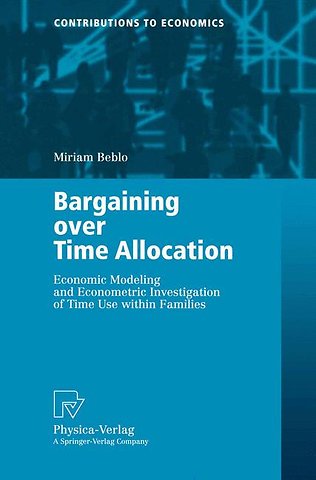
Miriam Beblo
Physica-Verlag HD
0e druk, 2001
9783790813913
Bargaining over Time Allocation
Economic Modeling and Econometric Investigation of Time Use within Families
Specificaties
Paperback, 139 blz.
|
Engels
Physica-Verlag HD |
2001
ISBN13: 9783790813913
Rubricering
Onderdeel van serie
Contributions to Economics
Levertijd ongeveer 9 werkdagen
Gratis verzonden
Samenvatting
In this book, time use behavior within households is modeled as the outcome of a bargaining process between family members who bargain over household resource allocation and the intrafamily distribution of welfare. In view of trends such as rising female employment along with falling fertility rates and increasing divorce rates, a strategic aspect of female employment is analyzed in a dynamic family bargaining framework. The division of housework between spouses and the observed leisure differential between women and men are investigated within non-cooperative bargaining settings. The models developed are tested empirically using data from the German Socio-Economic Panel and the German Time Budget Survey.
Specificaties
ISBN13:9783790813913
Taal:Engels
Bindwijze:paperback
Aantal pagina's:139
Uitgever:Physica-Verlag HD
Druk:0
Hoofdrubriek:Economie, Mens en maatschappij
Inhoudsopgave
1 Introduction.- 1.1 Time allocation in a bargaining family.- 1.2 Time use.- 1.3 The family as an economic institution.- 1.4 A reader’s guide.- 2 Theories on intrafamily time allocation.- 2.1 The unitary model.- 2.2 Under critique.- 2.3 Bargaining models.- 2.3.1 Cooperative bargaining.- 2.3.2 Non-cooperative bargaining.- 2.3.3 Dynamic models.- 2.3.4 Summing up.- 3 Empirical evidence on intrafamily time allocation.- 3.1 Introduction.- 3.2 Testing for unitary income pooling.- 3.3 Testing for Slutsky symmetry.- 3.4 Testing for Pareto efficiency.- 3.5 Testing for the impact of EEPs and decision-making power.- 3.6 A starting point for further research.- 4 The strategic aspect of female labor supply.- 4.1 Introduction.- 4.2 A dynamic bargaining model.- 4.2.1 Implications.- 4.2.2 Discussion of the theoretical results.- 4.3 Empirical implementation of the bargaining effect of labor supply.- 4.3.1 The virtual conflict payoff.- 4.3.2 Data set and sample characteristics.- 4.3.3 Female labor force participation with virtual conflict payoffs.- 4.3.4 Bargaining variables.- 4.3.5 Estimation procedure.- 4.3.6 Empirical findings.- 4.4 Conclusions.- 4.5 Further research.- 5 A panel-econometric analysis of the division of housework time.- 5.1 Introduction.- 5.2 The time use of employed couples.- 5.3 Theoretical approaches to intrafamily time allocation.- 5.4 The division of housework time: estimation results.- 5.4.1 Pooled sample.- 5.4.2 Fixed effects.- 5.4.3 Random effects.- 5.4.4 Mixed specification.- 5.5 Conclusions.- 5.6 Appendix.- 6 Leisure — A model on private provision of family public goods.- 6.1 Introduction.- 6.2 The model.- 6.3 The Stackelberg game.- 6.4 Conclusions.- 7 The leisure gap between working parents.- 7.1 Introduction.- 7.2 Basic facts of intrafamily distribution of leisure.- 7.3 The distribution of leisure as an alternating offers game.- 7.3.1 The setting.- 7.3.2 The structure of the game.- 7.4 The distribution of leisure — estimation results.- 7.5 Conclusions.- 8 Resume.- 8.1 Principal findings.- 8.2 Policy implications.- 8.3 The next step: cooperative conflicts in a qualitative bargaining framework.- List of figures.- List of tables.- References.
Anderen die dit kochten, kochten ook
-
 Nassim Nicholas Taleb€ 24,99
 -
Brenda de Zeeuw€ 43,95
-
Jonah Berger€ 25,88
-
Paul Schenderling€ 27,50
-
Peter Antonioni€ 29,99
-
Rick Hayes€ 91,99