Sara Nowakowski,
Sheila Garland,
Michael A. Grandner,
Leisha Cuddihy
e.a.
Elsevier Science
e druk, 2021
9780128228722
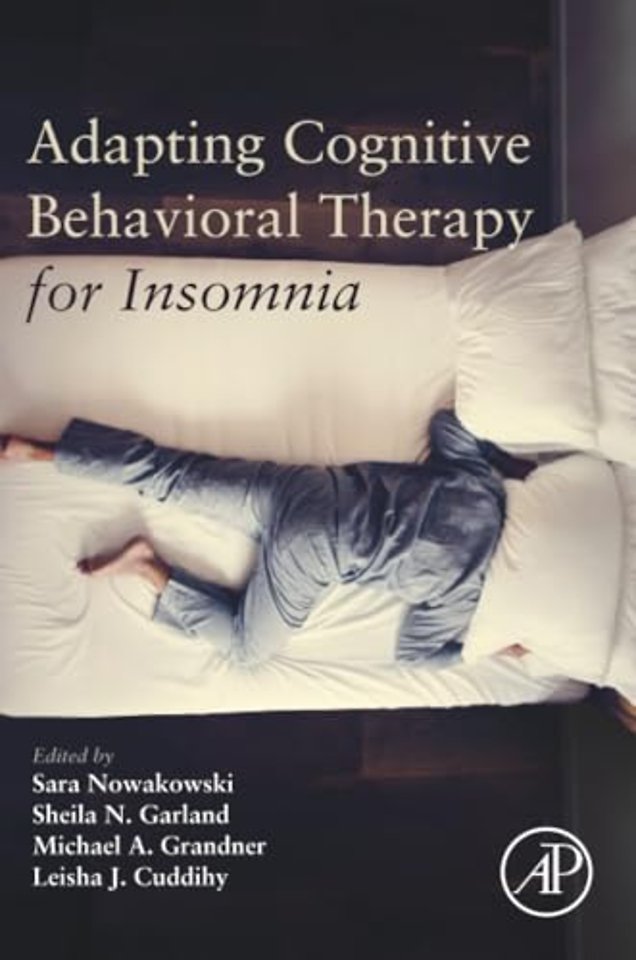
Adapting Cognitive Behavioral Therapy for Insomnia
Specificaties
Paperback, blz.
|
Engels
Elsevier Science |
2021
ISBN13: 9780128228722
Rubricering
Levertijd ongeveer 9 werkdagen
Gratis verzonden
Samenvatting
Cognitive behavioral therapy for insomnia (CBT-I) has emerged as the standard first-line treatment for insomnia. The number of patients receiving non-medication treatments is increasing, and there is a growing need to address a wide range of patient backgrounds, characteristics, and medical and psychiatric comorbidities. Adapting Cognitive Behavioral Therapy for Insomnia identifies for clinicians how best to deliver and/or modify CBT-I based on the needs of their patients. The book recommends treatment modifications based on patient age, comorbid conditions, and for various special populations.
Specificaties
Inhoudsopgave
<p>Preface<br>Acknowledgments</p> <p>Part 1: Traditional CBT-I components and delivery</p> <p>1. Standard cognitive behavioral therapy for insomnia (CBT-I)<br>Alexandria Muench, Ivan Vargas, Donn Posner, and Michael L. Perlis</p> <p>Part 2: CBT-I in other sleep disorders</p> <p>2. CBT-I in patients with obstructive sleep apnea<br>Earl Charles Crew</p> <p>3. CBT-I for patients with phase disorders or insomnia with circadian misalignment<br>Marissa A. Evans and Brant P. Hasler</p> <p>4. CBT-I for patients with shift work disorder<br>Philip Cheng</p> <p>5. CBT-I for patients with hypersomnia disorders<br>Jason C. Ong and Matthew D. Schuiling</p> <p>6. CBT-I for patients with orthosomnia<br>Kelly Glazer Baron</p> <p>Part 3: CBT-I in psychiatric disorders</p> <p>7. CBT-I for patients with depression<br>Jennifer Goldschmied and Philip Gehrman</p> <p>8. CBT-I for patients with schizophrenia and other psychotic disorders<br>Andrew Scott Tubbs and Michael A. Grandner</p> <p>9. CBT-I for people diagnosed with bipolar disorder: Moving from a disorder-focused to a transdiagnostic conceptualization<br>Allison G. Harvey and Caitlin E. Gasperetti</p> <p>10. CBT-I in patients with alcohol use and cannabis use disorders<br>Gabrielle E. Bowyer, Trevor M. Brooks, and Deirdre A. Conroy</p> <p>Part 4: CBT-I in medical disorders</p> <p>11. CBT-I for patients with chronic pain<br>Leisha J. Cuddihy, Sara Nowakowski, Michael A. Grandner, Jessica M. Meers,<br>and Michael T. Smith</p> <p>12. CBT-I during and after a cancer diagnosis<br>Sheila N. Garland</p> <p>13. CBT-I in patients with a history of traumatic brain injury<br>Erin A. Almklov, Guadalupe L. Rivera, and Henry Orff</p> <p>Part 5: CBT-I across the lifespan</p> <p>14. CBT-I for adolescents<br>Melisa E. Moore and Alison R. Hartman</p> <p>15. CBT-I in pregnancy<br>Anna L. MacKinnon, Ivan D. Sedov, and Lianne M. Tomfohr-Madsen</p> <p>16. CBT-I for perimenopause and postmenopause<br>Jessica M. Meers, Darius B. Dawson, and Sara Nowakowski</p> <p>17. CBT-I for older adults<br>Jaime M. Hughes and Jennifer L. Martin</p> <p>Part 6: Other special considerations</p> <p>18. CBT-I in the short sleep duration phenotype<br>Julio Fernandez-Mendoza</p> <p>19. CBT-I for people who failed CBT-I<br>Michael A. Grandner, Denise Rodriguez Esquivel, and Spencer Dawson</p> <p>20. CBT-I in patients who wish to reduce use of hypnotic medication<br>Norah Simpson and Rachel Manber</p>