, , , , , , , e.a.

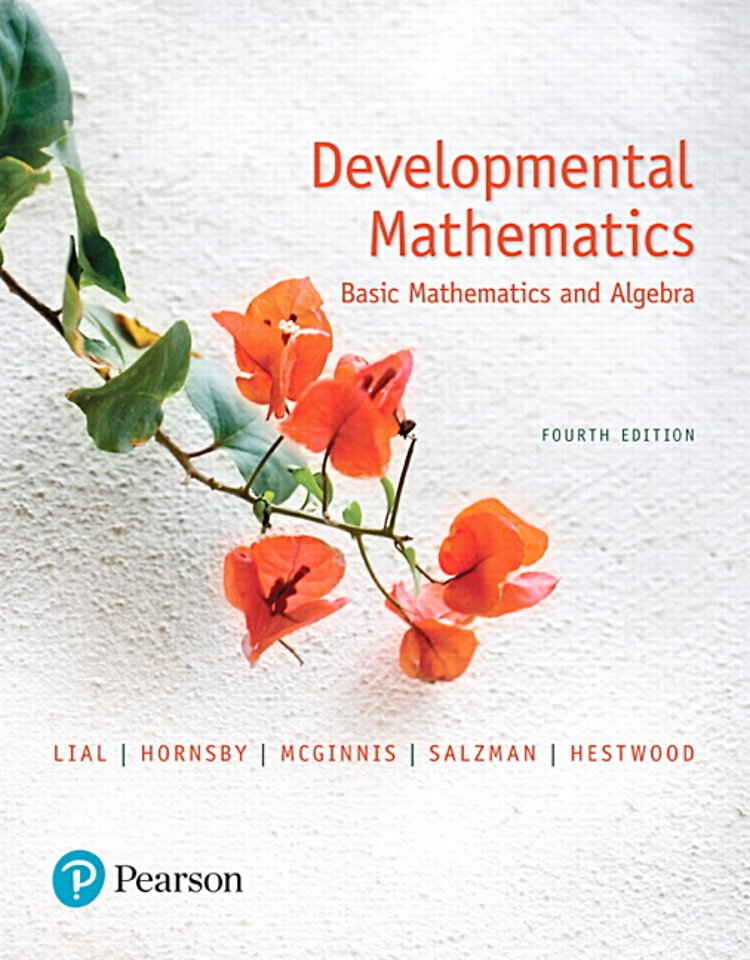
Developmental Mathematics

Basic Mathematics and Algebra

Specificaties
Paperback, blz. | Engels
Pearson Education | 2017
ISBN13: 9780134539812
Rubricering
Pearson Education e druk, 2017 9780134539812
€ 272,14
Levertijd ongeveer 9 werkdagen
Gratis verzonden

Samenvatting

For courses in Basic Math & Beginning Algebra.


The perfect combination to master concepts: student-friendly writing, well-crafted exercises, and superb support

The Lial Series has helped thousands of students succeed in developmental mathematics by combining clear, concise writing and examples with carefully crafted exercises to support skill development and conceptual understanding. Written with the developmental learner in mind, the precise, accessible writing style delivers help precisely when needed. The revision of the series faithfully continues to support students with enhancements in the text and MyLab™ Math course to encourage conceptual understanding beyond skills and procedures. Student-oriented features throughout the text and MyLab Math, including the Relating Concepts exercises, Guided Solutions, Test Your Word Power, and the Lial Video Library, make the Lial series one of the most well-rounded and student-friendly on the market.


Also available with MyLab Math

MyLab™ Math is an online homework, tutorial, and assessment program designed to work with this text to engage students and improve results. Within its structured environment, students practice what they learn, test their understanding, and pursue a personalized study plan that helps them absorb course material and understand difficult concepts.

Students, if interested in purchasing this title with MyLab Math, ask your instructor for the correct package ISBN and Course ID. Instructors, contact your Pearson representative for more information.

Specificaties

ISBN13:9780134539812
Taal:Engels
Bindwijze:Paperback

Inhoudsopgave

<p><strong>Preface</strong></p> <p><strong>CHAPTER 1 Whole Numbers</strong></p> <p><strong>1.1 </strong>Reading and Writing Whole Numbers</p> <p><strong>1.2 </strong>Adding Whole Numbers</p> <p><strong>1.3 </strong>Subtracting Whole Numbers</p> <p><strong>1.4 </strong>Multiplying Whole Numbers</p> <p><strong>1.5 </strong>Dividing Whole Numbers</p> <p><strong>1.6 </strong>Long Division</p> <p><strong>1.7 </strong>Rounding Whole Numbers</p> <p><strong>1.8 </strong>Exponents, Roots, and Order of Operations</p> <p><strong>1.9 </strong>Reading Pictographs, Bar Graphs, and Line Graphs</p> <p><strong>1.10 </strong>Solving Application Problems</p> <p><strong>CHAPTER 2 Multiplying and Dividing Fractions</strong></p> <p><strong>2.1 </strong>Basics of Fractions</p> <p><strong>2.2 </strong>Mixed Numbers</p> <p><strong>2.3 </strong>Factors</p> <p><strong>2.4 </strong>Writing a Fraction in Lowest Terms</p> <p><strong>2.5 </strong>Multiplying Fractions</p> <p><strong>2.6 </strong>Applications of Multiplication</p> <p><strong>2.7 </strong>Dividing Fractions</p> <p><strong>2.8 </strong>Multiplying and Dividing Mixed Numbers</p> <p><strong>CHAPTER 3 Adding and Subtracting Fractions</strong></p> <p><strong>3.1 </strong>Adding and Subtracting Like Fractions</p> <p><strong>3.2 </strong>Least Common Multiples</p> <p><strong>3.3 </strong>Adding and Subtracting Unlike Fractions</p> <p><strong>3.4 </strong>Adding and Subtracting Mixed Numbers</p> <p><strong>3.5 </strong>Order Relations and the Order of Operations</p> <p><strong>CHAPTER 4 Decimals</strong></p> <p><strong>4.1 </strong>Reading and Writing Decimal Numbers</p> <p><strong>4.2 </strong>Rounding Decimal Numbers</p> <p><strong>4.3 </strong>Adding and Subtracting Decimal Numbers</p> <p><strong>4.4 </strong>Multiplying Decimal Numbers</p> <p><strong>4.5 </strong>Dividing Decimal Numbers</p> <p><strong>4.6 </strong>Fractions and Decimals</p> <p><strong>CHAPTER 5 Ratio and Proportion</strong></p> <p><strong>5.1 </strong>Ratios</p> <p><strong>5.2 </strong>Rates</p> <p><strong>5.3 </strong>Proportions</p> <p><strong>5.4 </strong>Solving Proportions</p> <p><strong>5.5 </strong>Solving Application Problems with Proportions</p> <p><strong>CHAPTER 6 Percent</strong></p> <p><strong>6.1 </strong>Basics of Percent</p> <p><strong>6.2 </strong>Percents and Fractions</p> <p><strong>6.3 </strong>Using the Percent Proportion and Identifying the Components in a Percent Problem</p> <p><strong>6.4 </strong>Using Proportions to Solve Percent Problems</p> <p><strong>6.5 </strong>Using the Percent Equation</p> <p><strong>6.6 </strong>Solving Application Problems with Percent</p> <p><strong>6.7 </strong>Simple Interest</p> <p><strong>6.8 </strong>Compound Interest</p> <p><strong>CHAPTER 7 Geometry</strong></p> <p><strong>8.1 </strong>Basic Geometric Terms</p> <p><strong>8.2 </strong>Angles and Their Relationships</p> <p><strong>8.3 </strong>Rectangles and Squares</p> <p><strong>8.4 </strong>Parallelograms and Trapezoids</p> <p><strong>8.5 </strong>Triangles</p> <p><strong>8.6 </strong>Circles</p> <p><strong>8.7 </strong>Volume</p> <p><strong>8.8 </strong>Pythagorean Theorem</p> <p><strong>8.9 </strong>Similar Triangles</p> <p><strong>CHAPTER 8 Statistics</strong></p> <p><strong>8.1 </strong>Circle Graphs</p> <p><strong>8.2 </strong>Bar Graphs and Line Graphs</p> <p><strong>8.3 </strong>Frequency Distributions and Histograms</p> <p><strong>8.4 </strong>Mean, Median, and Mode</p> <p><strong>CHAPTER 9 The Real Number System</strong></p> <p><strong>9.1 </strong>Exponents, Order of Operations, and Inequality</p> <p><strong>9.2 </strong>Variables, Expressions, and Equations</p> <p><strong>9.3 </strong>Real Numbers and the Number Line</p> <p><strong>9.4 </strong>Adding Real Numbers</p> <p><strong>9.5 </strong>Subtracting Real Numbers</p> <p><strong>9.6 </strong>Multiplying and Dividing Real Numbers</p> <p><strong>9.7 </strong>Properties of Real Numbers</p> <p><strong>9.8 </strong>Simplifying Expressions</p> <p><strong>CHAPTER 10 Equations, Inequalities, and Applications <br>10.1 </strong>The Addition Property of Equality</p> <p><strong>10.2 </strong>The Multiplication Property of Equality</p> <p><strong>10.3 </strong>More on Solving Linear Equations</p> <p><strong>10.4 </strong>An Introduction to Applications of Linear Equations</p> <p><strong>10.5 </strong>Formulas and Additional Applications from Geometry</p> <p><strong>10.6 </strong>Solving Linear Inequalities</p> <p><strong>CHAPTER 11 Graphs of Linear Equations and Inequalities in Two Variables</strong></p> <p><strong>11.1 </strong>Linear Equations and Rectangular Coordinates</p> <p><strong>11.2 </strong>Graphing Linear Equations in Two Variables</p> <p><strong>11.3 </strong>The Slope of a Line</p> <p><strong>11.4 </strong>Slope-Intercept Form of a Linear Equation</p> <p><strong>11.5 </strong>Point-Slope Form of a Linear Equation and Modeling</p> <p><strong>11.6 </strong>Graphing Linear Inequalities in Two Variables</p> <p><strong>CHAPTER 12 Exponents and Polynomials</strong></p> <p><strong>12.1 </strong>The Product Rule and Power Rules for Exponents</p> <p><strong>12.2 </strong>Integer Exponents and the Quotient Rule</p> <p><strong>12.3 </strong>An Application of Exponents: Scientific Notation</p> <p><strong>12.4 </strong>Adding and Subtracting Polynomials</p> <p><strong>12.5 </strong>Multiplying Polynomials</p> <p><strong>12.6 </strong>Special Products</p> <p><strong>12.7 </strong>Dividing a Polynomial by a Monomial</p> <p><strong>12.8 </strong>Dividing a Polynomial by a Polynomial</p> <p><strong>CHAPTER 13 Factoring and Applications</strong></p> <p><strong>13.1 </strong>Greatest Common Factors; Factor by Grouping</p> <p><strong>13.2 </strong>Factoring Trinomials</p> <p><strong>13.3 </strong>Factoring Trinomials by Grouping</p> <p><strong>13.4 </strong>Factoring Trinomials Using the FOIL Method</p> <p><strong>13.5 </strong>Special Factoring Techniques</p> <p><strong>13.6 </strong>Solving Quadratic Equations Using the Zero-Factor Property</p> <p><strong>13.7 </strong>Applications of Quadratic Equations</p> <p><strong>CHAPTER 14 Rational Expressions and Applications</strong></p> <p><strong>14.1 </strong>The Fundamental Property of Rational Expressions</p> <p><strong>14.2 </strong>Multiplying and Dividing Rational Expressions</p> <p><strong>14.3 </strong>Least Common Denominators</p> <p><strong>14.4 </strong>Adding and Subtracting Rational Expressions</p> <p><strong>14.5 </strong>Complex Fractions</p> <p><strong>14.6 </strong>Solving Equations with Rational Expressions</p> <p><strong>14.7 </strong>Applications of Rational Expressions</p> <p><strong>14.8 </strong>Variation</p> <p><strong>CHAPTER 15 Systems of Linear Equations and Inequalities</strong></p> <p><strong>15.1 </strong>Solving Systems of Linear Equations by Graphing</p> <p><strong>15.2 </strong>Solving Systems of Linear Equations by Substitution</p> <p><strong>15.3 </strong>Solving Systems of Linear Equations by Elimination</p>
€ 272,14
Levertijd ongeveer 9 werkdagen
Gratis verzonden

Rubrieken

    Personen

      Trefwoorden

        Developmental Mathematics