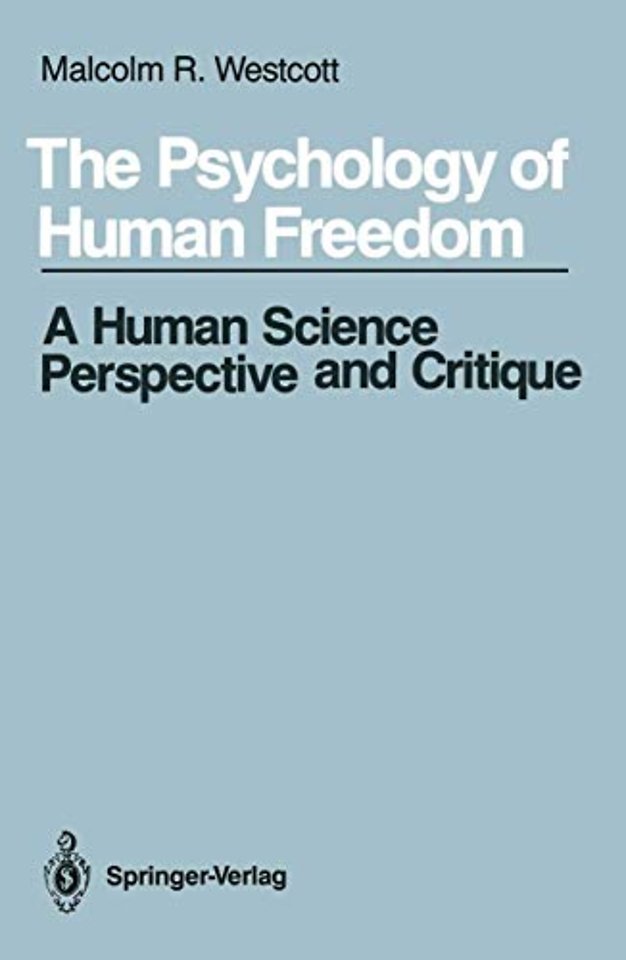
The Psychology of Human Freedom
A Human Science Perspective and Critique
Samenvatting
In this book I pursue three goals. The first is to describe what has been learned about human freedom through psychological research. The second is to provide a conceptual and methodological critique of the large body of that research which has been conducted within the framework of a positivist natural science ex perimental social psychology. My third goal is to offer a contrasting human science approach to the study of human freedom and to illustrate its use in empirical study. For more than twenty years psychologists have inves tigated the conditions under which people are seen to be free, the conditions under which they report feeling free, the psychological consequences of interference with be havioural freedoms, and to a lesser extent, how it feels to feel free. Empirical fmdings on each of these facets of human freedom have arisen in quite separate research traditions, and they are brought together here for the first time. During the same twenty years, a general critique of the dominant positivist natural science approach to complex human phenomena has been growing. Although it has escalated recently, this critique has fIrm roots that go back to the turn of the century. I review this general critique and apply it specifically to the study of human freedom - surely a complex human phenomenon, more complex, ambiguous, and paradoxical than most of us im agine.
Specificaties
Inhoudsopgave
Anderen die dit kochten, kochten ook
-
 Glenn de Randamie (Typhoon)€ 22,99
 -
Jos de Groot€ 24,99
-
Marianne Heemskerk€ 29,95
-
Bram Schaper€ 24,99
-
Dieter Möckelmann€ 16,95
-
John Macionis€ 66,95