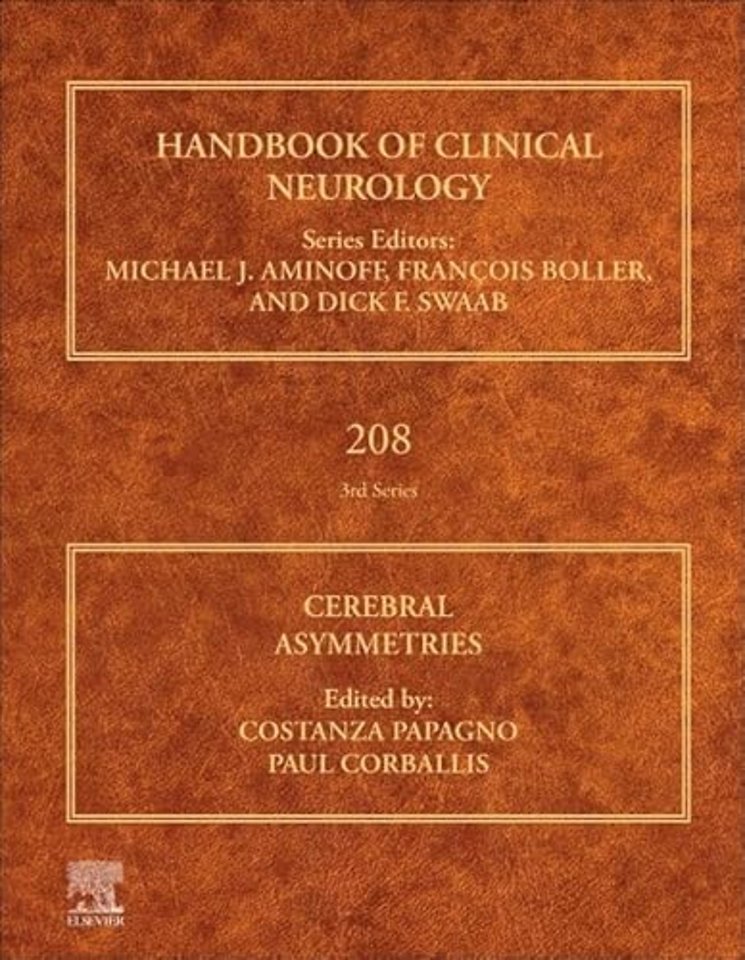
Cerebral Asymmetries
Specificaties
Gebonden, blz.
|
Engels
Elsevier Science |
2025
ISBN13: 9780443156465
Rubricering
Onderdeel van serie
Handbook of Clinical Neurology
Levertijd ongeveer 9 werkdagen
Gratis verzonden
Samenvatting
Cerebral Asymmetries, Volume 208 summarizes research on cerebral hemispheric asymmetries and their implication for consciousness cognition, language emotion, behavior movement, and neurological disease. The book discusses anatomy and networks, genetics, hormones, and evolution, although it is primarily focused on animal research as it relates back to humans.
Specificaties
Inhoudsopgave
<p>1. Cerebral asymmetry – Historical introduction<br><br>Section I. Anatomical asymmetries<br>2. Asymmetries in the human brain<br>3. Latent dimensions of brain asymmetry<br>4. On the relation between brain and visceral asymmetry: Evidence from situs inversus in humans<br><br>Section II. Clinical<br>5. Oncology - Brain asymmetries in language-relevant brain tumors<br>6. Cerebral asymmetries in schizophrenia<br>7. Hemispheric asymmetry in neurodegenerative diseases<br><br>Section III. Consciousness/Attention<br>8. Interhemispheric differences in visual attention<br>9. Left-and right-side unilateral spatial neglect. Hemispheric differences<br>10. Split-brain patients: A clinical versus experimental perspective<br><br>Section IV. Development and Lifespan<br>11. Aging<br>12. Development of handedness and other lateralized functions during infancy and early childhood<br><br>Section V. Genetics, Hormones, Evolution<br>13. Handedness and brain asymmetries in nonhuman primates<br>14. Brain and behavioral asymmetries in non-primate species<br>15. Hemispheric asymmetries, paleoneurology, and the evolution of the human genus<br>16. Large-scale genetic mapping for human brain asymmetry<br>17. Sex/gender differences in hemispheric asymmetries<br><br>Section VI. Language<br>18. Functional and structural brain asymmetries in language processing<br>19. Brain asymmetries in figurative language comprehension<br>20. Lateralization of reading and visual word processing<br>21. Functional and structural brain asymmetries in sign language processing<br>22. Unveiling the hemispheric specialization of language: Organization and neuroplasticity<br><br>Section VII. Movement/Motor Asymmetries/Cerebellum<br>23. Cerebellar asymmetries<br>24. Handedness<br>25. Hemispheric asymmetries in the control of upper limb movements<br><br>Section IIX. Other Cognitive and Perceptual Function<br>26. The arts and hemispheric specialization<br>27. Emotion: An evolutionary model of lateralization in the human brain<br>28. Hemispheric asymmetries in face recognition in health and dysfunction<br>29. Hemispheric asymmetries in episodic memory<br>30. Brain laterality of numbers and calculation. Complex networks and their development<br>31. Seeing and visualizing across the hemispheres<br> </p>