Syra S. Madad,
Laura G. Iavicoli,
Eric K. Wei
Elsevier Science
e druk, 2024
9780443187551
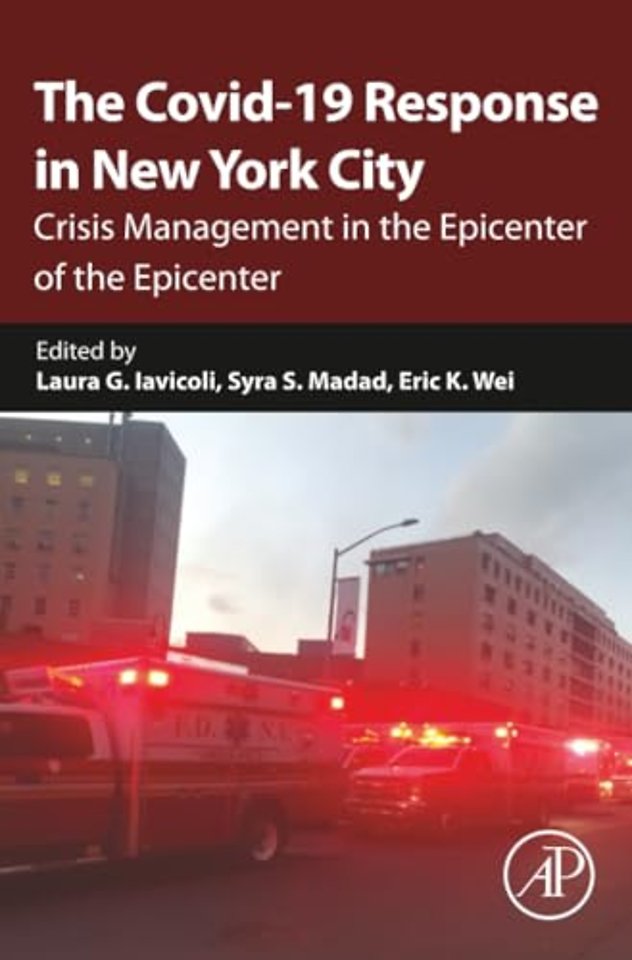
The Covid-19 Response in New York City
Crisis Management in the Epicenter of the Epicenter
Specificaties
Paperback, blz.
|
Engels
Elsevier Science |
2024
ISBN13: 9780443187551
Rubricering
Levertijd ongeveer 9 werkdagen
Gratis verzonden
Samenvatting
The COVID-19 Response in New York City: Crisis Management in the Largest Public Health System provides an historical accounting of the response to the COVID-19 pandemic through the eyes of the largest public health system in the United States. The book offers a roadmap to guide healthcare systems and their providers in the event of future pandemics. Readers will learn about surge staffing and level loading, as well as tips from the ED and ICUs on how to respond to an unprecedented influx of inpatients.
Written by healthcare providers who were at the epicenter of the pandemic in New York City, this book provides a sound accounting of the response to the pandemic in one of the world's largest cities.
Specificaties
Inhoudsopgave
Section I: In the beginning<br>1. Standing up the emergency response in the epicenter of the epicenter<br>Colleen Smith, Suzanne (Suzi) Bentley, Geoff Jara-Almonte, Veronica Delgado, Phillip Fairweather, Cathy Lind, Ram Parekh, Stuart Kessler and Laura Iavicoli<br>2. The history of NYC Health þ Hospitals<br>P.J. Rosenstock, Machelle Allen and Nate Link<br>Section II: The pivotal moment<br>3. Emergency Departments spring into action<br>Jeremy Sperling, Adrienne Birnbaum and Rajneesh Gulati<br>4. The crisis shifted to the intensive care units<br>Alfredo Astua, Leon Boudourakis, Marialeah Cervantes, Matthew Langston, Vikramjit Mukherjee, Vito Stasolla and Amit Uppal<br>Section III: A system surge plan put into place<br>5. Bringing key players together, standing up incident command, and communicating with everyone<br>Matt Siegler, Christine Flaherty, Ana Marengo, Menji Indar, Manuel Saez, Priya Dhagat, Christopher Montgomery and Eric Wei<br>6. The iterations of patient movement throughout the surge: Load-balancing demand through interfacility transfers<br>Katelyn B. Prieskorn, R. James Salway and David M. Silvestri<br>7. Supply chain and PPE, the wave 1 dilemma<br>Priya Dhagat, Syra Madad, Danielle DiBari, Mary Fornek and Keith Tallbe<br>8. Staffing for pandemic surges in the NYC safety-net health system<br>Milana Zaurova, Wilbur Yen, Annika Ginsberg, Donna Boyle Schwartz, Jeannith Michelin and Natalia Cineas<br>9. Fatality management during the worst crisis of our lifetime<br>Jory Guttsman, Madeline Tavarez, William Fasbender and Stuart Rosenhaus<br>10. Fine tuning the surge (and flex) plan<br>Janice A. Halloran, Karen L. Mattera, Robert Faillace and Sheldon Teperman<br>Section IV: The technical side of the response<br>11. Situational awareness, going from flying blind to eyes on it all: DnA (Data and Analytics)<br>Angelie E. Oberoi, Bharti Sharma, Andrew M. Vegoda and Alexander G. Izaguirre<br>12. IT-coordinating the technology infrastructure of the system<br>Michael Bouton, Gabriel Cohen and Kim Mendez<br>13. Donations were a full-time job<br>Kwame Sheehy, Linh Dang and Freda Wang<br>Section V: Nuances of a massive health system<br>14. The correctional health response to COVID-19<br>Patsy Yang, Nancy Arias, Carlos Castellanos, Maria Creta, Ross MacDonald, Zachary Rosner and Bipin Subedi<br>15. Alternate care sites including hoteling, a new path in a massive surge response<br>Leon Boudourakis, Amanda K. Johnson, Nicole JordaneMartin, Floyd R. Long, Jr. Khoi Luong, Matilde Roman and Colleen Vessell<br>16. Behavioral health and COVID-19<br>Vladimir Gasca, Rebecca Linn-Walton, Emily Carter and Charles Barron<br>17. External affairs: Managing communications with regulators and stakeholders<br>Hillary Jalon, Deborah Brown, Andrea Cohen, Linda Dehart, Brenda Schultz and John Ulberg<br>Section VI: A light at the end of the tunnel<br>18. Testing and tracing in the “world’s capital”<br>Kym Neck, Alex Dobranic, Chris Keeley, Sarah Joseph Kurien, Kathleen Blaney, Andrew Wallach, Amanda Johnson, Steffen Foerster and Ted Long<br>19. Vaccines and outpatient therapeutics: The race against the variants and the road to normalcy<br>Andrew B. Wallach and Lee Fiebert<br>20. Wellness and Helping Healers Heal during the biggest crisis of our lifetime<br>Jeremy Segall, Omar Fattal and Suzanne (Suzi) Bentley<br>Section VII: Conclusion<br>21. The future of public healthcare delivery systems in the United States in the post-COVID era<br>Mitchell Katz