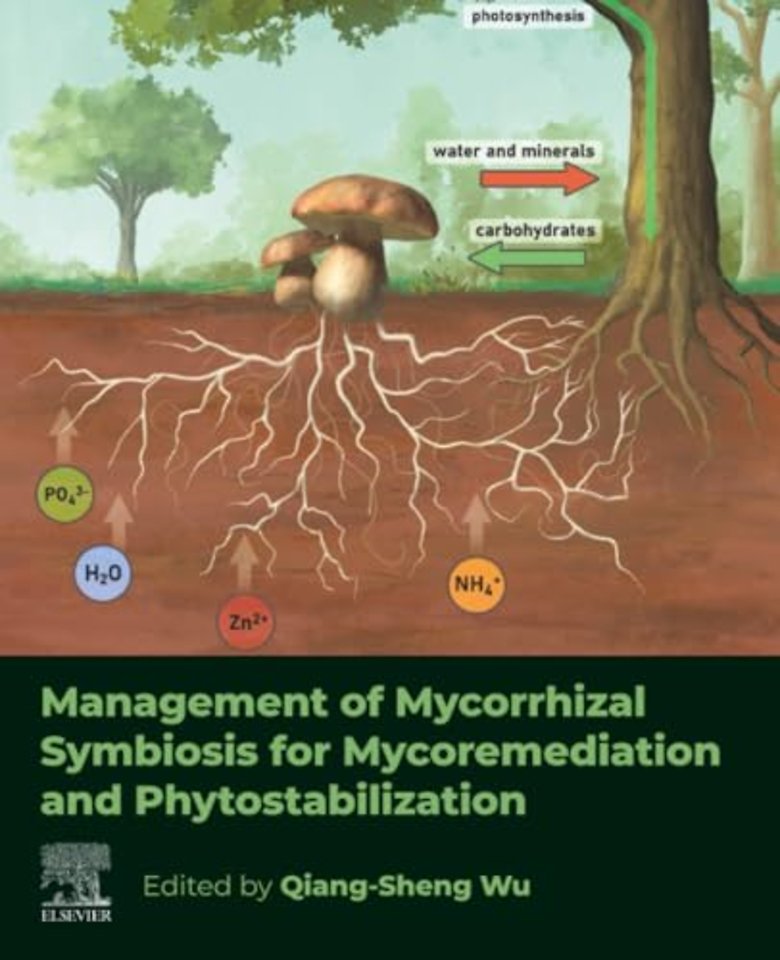

Management of Mycorrhizal Symbiosis for Mycoremediation and Phytostabilization

Specificaties
Paperback, blz. | Engels
Elsevier Science | 2025
ISBN13: 9780443248634
Rubricering
Elsevier Science e druk, 2025 9780443248634
€ 168,99
Levertijd ongeveer 9 werkdagen
Gratis verzonden

Samenvatting

Management of Mycorrhizal Symbiosis for Mycoremediation and Phytostabilization overviews the many advances that have been made in mycorrhizal research and practice. Many microorganisms are present in plant rhizosphere, among which root-associated mycorrhizal fungi are ancient fungi that have evolved along with the evolution of plants. Mycorrhizal fungi of the soil can colonize more than 80% of terrestrial plant roots, where the mycorrhizal symbiosis helps the host to obtain water and nutrients, in exchange of lipids and sugars from the host plant to the mycorrhizal fungus for its life history. The mycorrhizal extraradical mycelium can extend beyond the root zone, enabling the absorption of water and nutrients from the soil. Thus, the reciprocal symbiosis can provide an important technology for crop reduction of fertilizer inputs and environmental stewardship. Mycorrhizal fungal fertilizers have been produced commercially in Europe, Asia, and North America, which provides strong support for mycorrhizal applications in agriculture and environmental field. Therefore, there is a great need to summarize the recent research results and bring them together in a book. This book provides soil scientists and mycorrhizal researchers with a comprehensive overview of new advances in mycorrhizal fungi. It may also serve as a reference for professionals in adjacent fields working in environmental management, microbiology, and crop science.

Specificaties

ISBN13:9780443248634
Taal:Engels
Bindwijze:Paperback

Inhoudsopgave

1. Fatty acids as a carbon and energy source for the asymbiotic development of AM fungi<br>2. Arbuscular mycorrhizal fungi: belowground drivers of plant nutrition<br>3. Regulation of gene expression in mycorrhizal symbiosis<br>4. AM fungi-associated glomalin and plant growth: A visual analysis<br>5. Glomalin related soil protein: A potential soil conditioner and plant biostimulant<br>6. Improving melon yield, quality, and safety attributes: role of arbuscular mycorrhizal fungi<br>7. Significance of arbuscular mycorrhizal fungi in improving the growth, chemical profile, and biological activities of medicinal and aromatic plants<br>8. Role of arbuscular mycorrizal fungi in plant growth promotion and biotic stress management<br>9. Mycorrhizal fungi and nanotechnology for plant health<br>10. Mycorrhizal fungi in tropical agroecosystems in America<br>11. Potential of arbuscular mycorrhizal fungi to support the conservation effort of siompu citrus (Citrus nobilis I.)<br>12. The bioirrigation concept: contributions of the common mycorrhizal network in cereal-legume intercropping in rain fed agriculture<br>13. Mycorrhizal fungi in Brazilian tropical biomes<br>14. Biological control of the citrus nematodes Tylenchulus semipenetrans using arbuscular mycorrhizal fungi<br>15. Mycorrhizae and soil pathogens in tropical regions<br>16. Mycorrhizal fungi in infertile and weathered soils<br>17. Mycoremediation: A bio-based approach towards environmental sustainability<br>18. Mycorrhiza-assisted phytoremediation and food security: Opportunities and challenges to regain sustainability in soil–crop systems<br>19. Towards the integration of arbuscular mycorrhizal inoculants in sustainable agriculture. Results in Cuba. Progress and challenges
€ 168,99
Levertijd ongeveer 9 werkdagen
Gratis verzonden

Rubrieken

    Personen

      Trefwoorden

        Management of Mycorrhizal Symbiosis for Mycoremediation and Phytostabilization