Gastone G. Celesia,
Gregory Hickok
Elsevier Science
e druk, 2015
9780444626301
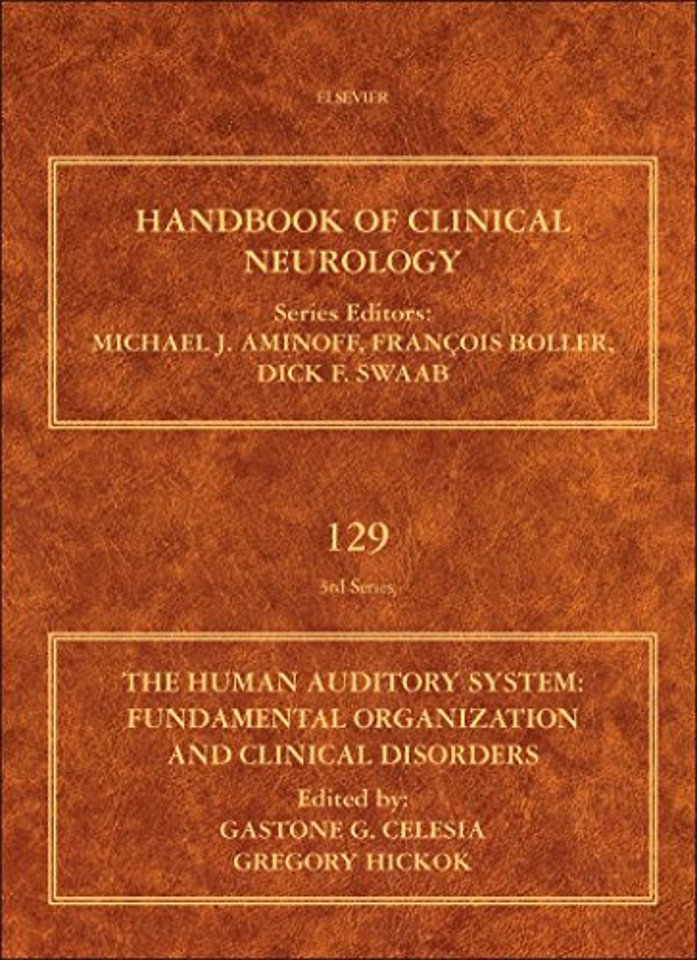
The Human Auditory System
Fundamental Organization and Clinical Disorders
Specificaties
Gebonden, blz.
|
Engels
Elsevier Science |
2015
ISBN13: 9780444626301
Rubricering
Onderdeel van serie
Handbook of Clinical Neurology
Levertijd ongeveer 9 werkdagen
Gratis verzonden
Samenvatting
The Human Auditory System: Fundamental Organization and Clinical Disorders provides a comprehensive and focused reference on the neuroscience of hearing and the associated neurological diagnosis and treatment of auditory disorders. This reference looks at this dynamic area of basic research, a multidisciplinary endeavor with contributions from neuroscience, clinical neurology, cognitive neuroscience, cognitive science communications disorders, and psychology, and its dramatic clinical application.
Specificaties
Inhoudsopgave
<p>Section 1. Anatomy and Physiology of the Human Auditory System<br>1. Auditory pathways: anatomy and physiology<br>2. Anatomical organization of the auditory cortex<br>3. Development of the auditory system<br>4. Representation of loudness in the auditory cortex<br>5. Temporal coding in the auditory cortex<br>6. Sound localization<br>7. Learning and plasticity in auditory cortex<br>8. Neural basis of speech perception<br>9. Role of the auditory system in speech production<br>10. White matter pathways for auditory and speech processing<br>11. Neural basis of music perception<br>12. Music and language: relations and disconnections</p> <p>Section 2. Methodology and Techniques<br>13. Invasive recordings in the human auditory cortex <br>14. Electromagnetic recording of the auditory system<br>15. Hemodynamic imaging of the auditory cortex<br>16. Imaging white matter pathways<br>17. Electrophysiological auditory tests<br>18. Psychophysical and behavioral peripheral and central auditory tests</p> <p>Section 3. Disorders of the Auditory System<br>19. Neurocognitive development in congenitally deaf children <br>20. Aging of the auditory system <br>21. Decreased sound tolerance: hyperacusis, misophonia, diplacousis and polyacousis<br>22. Auditory Synesthesias <br>23. Tinnitus<br>24. Auditory hallucinations<br>25. Palinacousis<br>26. Musicogenic Epilepsy <br>27. Deafness in cochlear and auditory nerve disorders <br>28. Auditory Neuropathy <br>29. Hearing disorders in Brain stem lesions <br>30. Central Auditory Processing Disorders in children and adults <br>31. Auditory neglect and related disorders<br>32. Auditory Agnosia<br>33. Congenital Amusias <br>34. Acquired Amusia<br>35. Hearing disorders in Stroke<br>36. Hearing disorders in Multiple Sclerosis <br>37. Hearing and Music in Dementia<br>38. Future Advances</p> <p><br> </p>