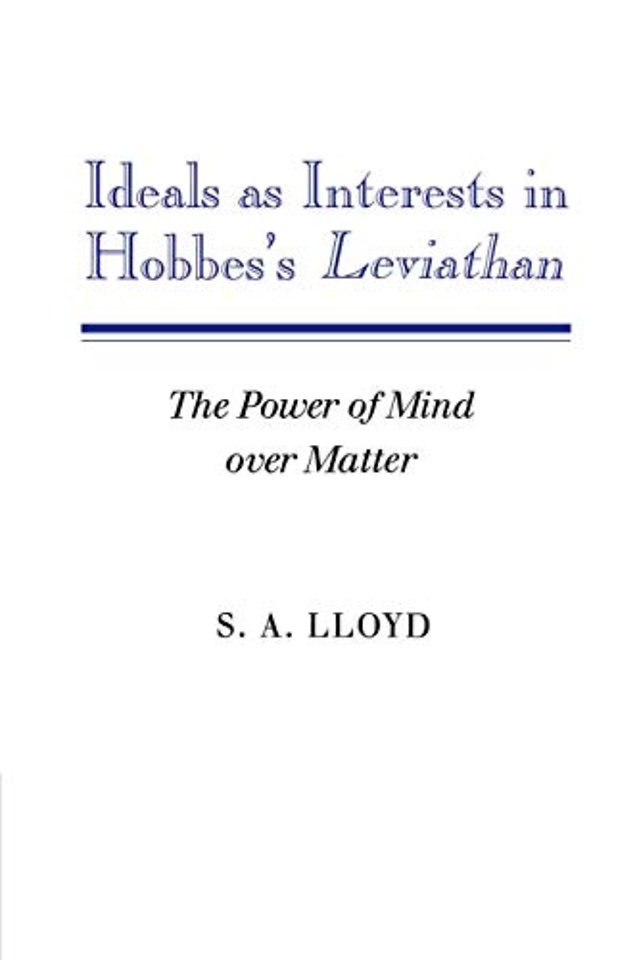
Ideals as Interests in Hobbes's Leviathan

The Power of Mind over Matter

Specificaties
Paperback, 412 blz. | Engels
Cambridge University Press | 2003
ISBN13: 9780521522328
Rubricering
Cambridge University Press e druk, 2003 9780521522328
€ 70,17
Levertijd ongeveer 9 werkdagen
Gratis verzonden

Samenvatting

S. A. Lloyd proposes a radically new interpretation of Hobbes's Leviathan that shows transcendent interests - interests that override the fear of death - to be crucial to both Hobbes's analysis of social disorder and his proposed remedy to it. Most previous commentators in the analytic philosophical tradition have argued that Hobbes thought that credible threats of physical force could be sufficient to deter people from political insurrection. Professor Lloyd convincingly shows that because Hobbes took the transcendence of religious and moral interests seriously, he never believed that mere physical force could ensure social order. Lloyd's interpretation demonstrates the ineliminability of that half of Leviathan devoted to religion, and attributes to Hobbes a much more plausible conception of human nature than the narrow psychological egoism traditionally attributed to Hobbes.

Specificaties

ISBN13:9780521522328
Taal:Engels
Bindwijze:Paperback
Aantal pagina's:412

Inhoudsopgave

Acknowledgments; A note on references; Introduction; 1. The standard philosophical interpretation; 2. Hobbes's compositive reconstruction, phase one: identification of the principle of political obligation; 3. Compositive reconstruction, phase two: religion and the redescription of transcendent interests; 4. Hobbes's mechanism for the reproduction of social stability; 5. Hobbes's resolutive analysis, phase two: part 4 of Leviathan; 6. Theory in practice: Leviathan and Behemoth; 7. Hobbes's resolutive analysis, phase one: design and detail; 8. The treatment of transcendent interests; 9. Hobbes's absolutism; Notes; Index.
€ 70,17
Levertijd ongeveer 9 werkdagen
Gratis verzonden

Rubrieken

    Personen

      Trefwoorden

        Ideals as Interests in Hobbes's Leviathan