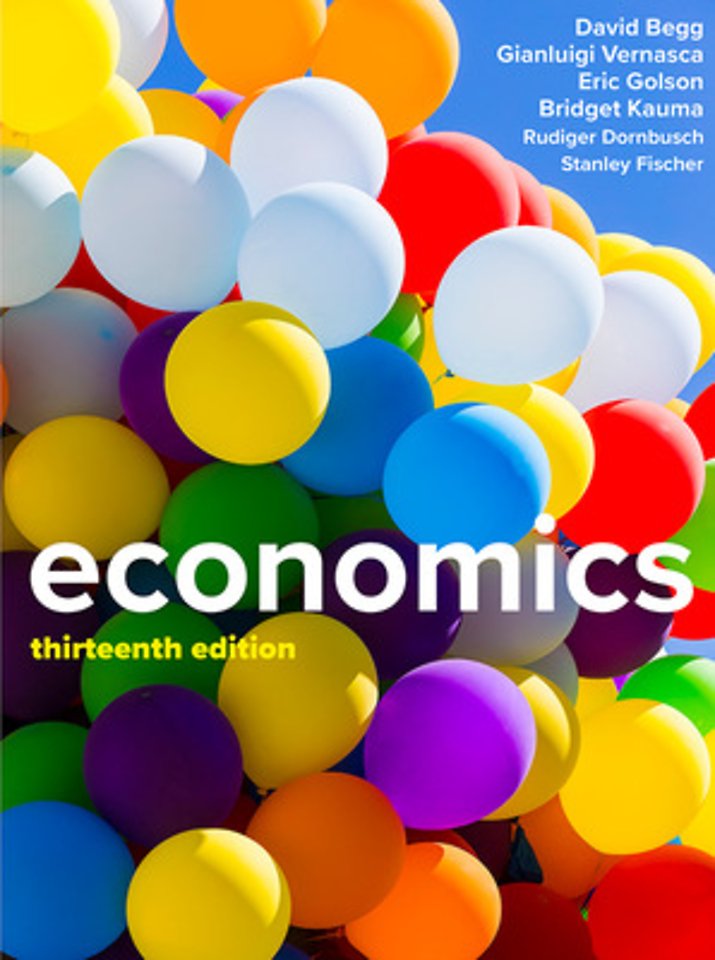
, , , , , e.a.

Economics, 13e

Specificaties
Paperback, blz. | Engels
McGraw-Hill Education | 13e druk, 2025
ISBN13: 9781526850232
Rubricering
McGraw-Hill Education 13e druk, 2025 9781526850232
€ 98,37
Levertijd ongeveer 11 werkdagen
Gratis verzonden

Samenvatting

Discover how the dynamic world of economics influences our daily lives, society, political decisions and environmental concerns. This thirteenth edition of Economics by David Begg, Gianluigi Vernasca, Eric Golson and Bridget Kauma, supports students understanding of economics by blending foundational principles with contemporary issues and applications.
Covering the latest economic topics, such as the global implications of war, the effects of macro-inflation and the role of AI in the labour market this new edition provides a thorough and insightful exploration that fosters critical thinking and informed decision-making. Perfect for anyone looking to deepen their economic knowledge and apply it effectively.

Key Features:
•Up to date insights: Fully updated chapters, including new material on AI, the continued impact of COVID-19 on consumer’s confidence and expanded material on climate change.
•Engaging pedagogy:  Across each chapter, theory is met with topical case studies, boxes on economic concepts and activity applications, showcasing the relevance and application of the material.
•Flexible learning: Economics is written with the reader in mind to allows students to learn at their own pace. End of chapter questions are graded by difficulty and math boxes are optional for technical ability to be scaffolded.
•Expert authors: Written by renowned economists with extensive experience in academia and practice.
•Digital material: A wealth of online resources including adaptive learning technology, application-based activities, graphing and maths prep, question banks and a full suite of instructor resources.

David Begg is Emeritus Professor of Economics at Imperial College London, and former Principle of the Business School. He is a fellow of the Royal Society of Edinburgh, a fellow of the City and Guilds of London Institute and senior independent director of IP Group, which invests in technology start-ups from leading universities in the UK, the US, and Australasia.

Gianluigi Vernasca is Professor of Economics at the University of Essex. Since October 2013 he has also been Director of Education in the Department of Economics. He is Senior Fellow of the Higher Education Academy and has taught economics at both undergraduate and postgraduate levels in various institutions.

Eric Golson is an Associate Professor of Economics at the University of Surrey, specializing in economic warfare and international political economy. His research includes trade warfare, economic sanctions, and military spending. An award-winning educator and advocate for diversity, he has published extensively and holds degrees from the London School of Economics and the University of Chicago.

Bridget Kauma is a Lecturer in Economics at the University of Sussex, where is also the Course Director for the BA Economics. Bridget is a fellow of the Higher Education Academy and teaches Economics at both the undergraduate and postgraduate levels. She received her PhD from the University of Sussex in 2022. Her research interests are in international trade with a particular emphasis on the intersection between productivity and labour markets. Prior to joining the academia Bridget worked as Chief Trade Officer in the Ministry of Trade in Malawi.

Specificaties

ISBN13:9781526850232
Taal:Engels
Bindwijze:paperback
Druk:13

Inhoudsopgave

<p style="box-sizing: border-box;margin: 0px 0px 10px;">PART ONE Introduction</p><p style="box-sizing: border-box;margin: 0px 0px 10px;">1 Economics and the economy</p><p style="box-sizing: border-box;margin: 0px 0px 10px;">2 Tools of economic analysis</p><p style="box-sizing: border-box;margin: 0px 0px 10px;">PART TWO Positive microeconomics</p><p style="box-sizing: border-box;margin: 0px 0px 10px;">3 Demand, supply and the market</p><p style="box-sizing: border-box;margin: 0px 0px 10px;">4 Elasticities of demand and supply</p><p style="box-sizing: border-box;margin: 0px 0px 10px;">5 Consumer choice and demand decisions</p><p style="box-sizing: border-box;margin: 0px 0px 10px;">6 Choice under uncertainty and behavioural economics</p><p style="box-sizing: border-box;margin: 0px 0px 10px;">7 Introducing supply decision</p><p style="box-sizing: border-box;margin: 0px 0px 10px;">8 Production, costs and supply</p><p style="box-sizing: border-box;margin: 0px 0px 10px;">9 Perfect competition and pure monopoly</p><p style="box-sizing: border-box;margin: 0px 0px 10px;">10 Market structure and imperfect competition</p><p style="box-sizing: border-box;margin: 0px 0px 10px;">11 Labour market</p><p style="box-sizing: border-box;margin: 0px 0px 10px;">12 Factor markets, income distribution, and inequality</p><p style="box-sizing: border-box;margin: 0px 0px 10px;">13 The economics of information</p><p style="box-sizing: border-box;margin: 0px 0px 10px;">PART THREE Welfare economics</p><p style="box-sizing: border-box;margin: 0px 0px 10px;">14 Welfare economics</p><p style="box-sizing: border-box;margin: 0px 0px 10px;">15 Government spending and revenue</p><p style="box-sizing: border-box;margin: 0px 0px 10px;">16 Governing the market</p><p style="box-sizing: border-box;margin: 0px 0px 10px;">PART FOUR Macroeconomics</p><p style="box-sizing: border-box;margin: 0px 0px 10px;">17 Introduction to macroeconomics</p><p style="box-sizing: border-box;margin: 0px 0px 10px;">18 Supply-side economics and economic growth</p><p style="box-sizing: border-box;margin: 0px 0px 10px;">19 Output and aggregate demand</p><p style="box-sizing: border-box;margin: 0px 0px 10px;">20 Fiscal policy and foreign trade</p><p style="box-sizing: border-box;margin: 0px 0px 10px;">21 Money, banking and financial markets</p><p style="box-sizing: border-box;margin: 0px 0px 10px;">22 Money demand, interest rates and monetary transmission</p><p style="box-sizing: border-box;margin: 0px 0px 10px;">23 Monetary and fiscal policy</p><p style="box-sizing: border-box;margin: 0px 0px 10px;">24 Aggregate supply, prices and adjustment to shocks</p><p style="box-sizing: border-box;margin: 0px 0px 10px;">25 Inflation, expectations and credibility</p><p style="box-sizing: border-box;margin: 0px 0px 10px;">26 Unemployment</p><p style="box-sizing: border-box;margin: 0px 0px 10px;">27 Exchange rates and the balance of payments</p><p style="box-sizing: border-box;margin: 0px 0px 10px;">28 Open economy macroeconomics</p><p style="box-sizing: border-box;margin: 0px 0px 10px;">29 Business cycles</p><p style="box-sizing: border-box;margin: 0px 0px 10px;">PART FIVE The world economy</p><p style="box-sizing: border-box;margin: 0px 0px 10px;">30 International trade</p><p style="box-sizing: border-box;margin: 0px 0px 10px;">31 Exchange rate regimes</p><p style="box-sizing: border-box;margin: 0px 0px 10px;">32 Globalization, national sovereignty and the world economy</p><p style="box-sizing: border-box;margin: 0px 0px 10px;">Appendix: Answers to activity and maths questions</p><p style="box-sizing: border-box;margin: 0px 0px 10px;">Glossary</p><p style="box-sizing: border-box;margin: 0px 0px 10px;">Index</p>
€ 98,37
Levertijd ongeveer 11 werkdagen
Gratis verzonden

Rubrieken

    Personen

      Trefwoorden

        Economics, 13e