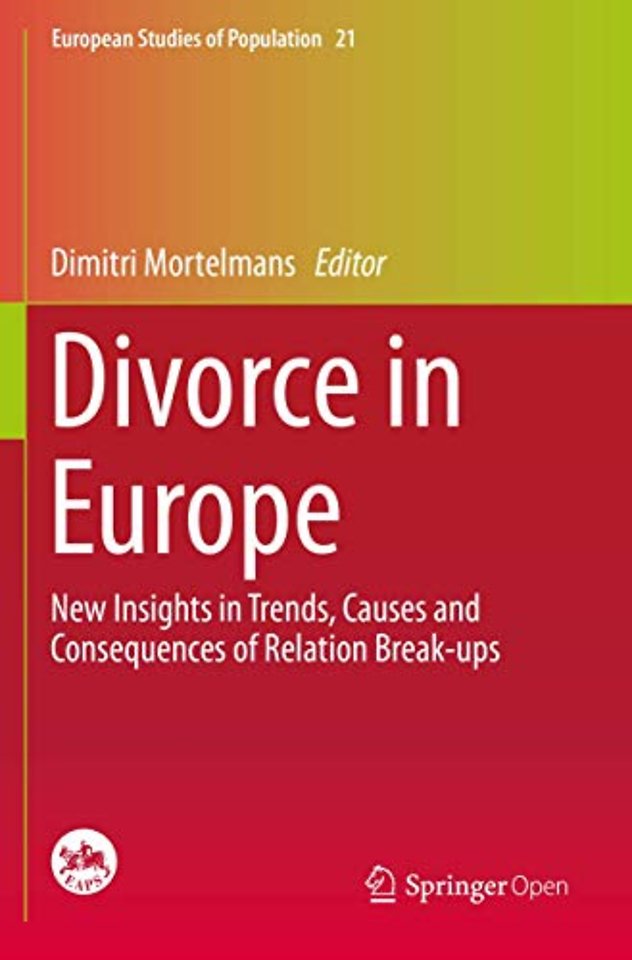
Divorce in Europe

New Insights in Trends, Causes and Consequences of Relation Break-ups

Specificaties
Paperback, blz. | Engels
Springer International Publishing | 2021
ISBN13: 9783030258405
Rubricering
Springer International Publishing e druk, 2021 9783030258405
Onderdeel van serie European Studies of Population
€ 60,99
Levertijd ongeveer 9 werkdagen
Gratis verzonden

Samenvatting

This open access book collects the major discussions in divorce research in Europe.  It starts with an understanding of divorce trends. Why was divorce increasing so rapidly throughout the US and Europe and do we see signs of a turn? Do cohabitation breakups influence divorce trends or is there a renewed stability on the partner market?

In terms of divorce risks, the book contains new insights on Eastern European countries. These post socialist countries have evolved dramatically since the fall of the Wall and at present they show the highest divorce figures in Europe. Also the influence of gender, and more specifically women’s education as a risk in divorce is examined cross nationally. The book also provides explanations for the negative gradient in female education effects on divorce.  It devotes three separate parts to new insights in the post-divorce effects of the life course event by among others looking at consequences for adults and children but also taking the larger family network into account. As such the book is of interest to demographers, sociologists, psychologists, family therapists, NGOs, and politicians.

“This wide-ranging volume details important trends in divorce in Europe that hold implications for understanding family dissolution causes and consequences throughout the world. Highly recommended for researchers and students everywhere.”

Specificaties

ISBN13:9783030258405
Taal:Engels
Bindwijze:paperback
Uitgever:Springer International Publishing

Inhoudsopgave

1. Introduction<p>Dimitri Mortelmans</p> <p>&nbsp;</p> <p>PART 1 DIVORCE TRENDS</p> <p>&nbsp;</p> <p>2. Estimating Trends in Relationship Stability over Time: Conceptual and Empirical Challenges</p> <p>Diederik Boertien</p> <p>&nbsp;</p> <p>3. On Increasing Divorce Risks</p> <p>Michael Wagner</p> <p>&nbsp;</p> <p>PART 2 DIVORCE RISKS</p> <p>&nbsp;</p> <p>4. Cohort trends in divorce in 8 post-socialist countries</p> <p>Sunnee Billingsley, Juho Härkönen</p> <p>&nbsp;</p> <p>5. The negative female educational gradient of divorce: Towards an explanation in four European countries</p> <p>Maike van Damme, Pearl Dykstra</p> <p>&nbsp;</p> <p>6. The More the Merrier? The Effect of Children on Divorce in a Pro-natalist Society</p> <p>Amit Kaplan, Miri Endeweld, Anat Herbst-Debby</p> <p>&nbsp;</p> <p>PART 3 CONSEQUENCES OF DIVORCE FOR ADULTS</p> <p>&nbsp;</p> <p>7. Exploring Divorce in Later Life, Social Isolation, and Loneliness</p> <p>Robin S. Högnäs</p> <p>&nbsp;</p> <p>8. Do divorced elderly in Russia get help from their children ?</p> <p>Ekaterina Tretyakova</p> <p>&nbsp;</p> <p>9. Coping strategies of migrant women after divorce. Does work, family or a new partner helps you through the dark times ? </p> <p>Dimitri Mortelmans, Layla Van den Bergh, Gert Tielemans</p> <p>&nbsp;</p> <p>10. Multi-dimensional subjective wellbeing (SWB), lone parenthood and divorce. How do different post-divorce family dynamics influence different measures of SWB?</p> <p>Sam Jenkinson, Koenraad Matthys, Hideko Matsuo</p> <p>&nbsp;</p> <p>PART 4 DIVORCE AND CHILDREN</p> <p>&nbsp;</p> <p>11. Childbearing Across Partnerships in Finland and Germany: Are There Any Gender Differences?</p> <p>Marika Jalovaara, Michaela Kreyenfeld</p> <p>&nbsp;</p> <p>12. Public attitudes towards the shared custody: Reflection of the rising notion of intergenerational commitment – the case of Czech Republic</p> <p>Petr Fučík</p> <p>&nbsp;</p> <p>13. Post-divorce multi-household living arrangements in Europe and child well-being</p> <p>Michael Gähler, Peter Fallesen</p> <p>&nbsp;</p> <p>14. Implications of grandparental divorce in grandchildren care</p> <p>Marius Neagu, Cornelia Muresan</p> <p>&nbsp;</p> <p>PART 5 FAMILY TIES AFTER DIVORCE</p> <p>&nbsp;</p> <p>15. Parental Divorce and Father-Child Relationships: A Closer Look at Broken Ties</p> <p>Matthijs Kalmijn</p> <p>&nbsp;</p> <p>16. Knotting the safety net. A theoretical framework in studying interdependencies in post-divorce family networks</p> <p>Dries Van Gasse, Vera de Bel, Dimitri Mortelmans</p> <p>&nbsp;</p> <p>17. Quality of non-resident father-child relationship: between “caring for” and “caring about”</p> <p>Aušra Maslauskaitė, Artūras Tereškinas</p> <p>&nbsp;</p> <p>&nbsp;</p>
€ 60,99
Levertijd ongeveer 9 werkdagen
Gratis verzonden

Rubrieken

    Personen

      Trefwoorden

        Divorce in Europe