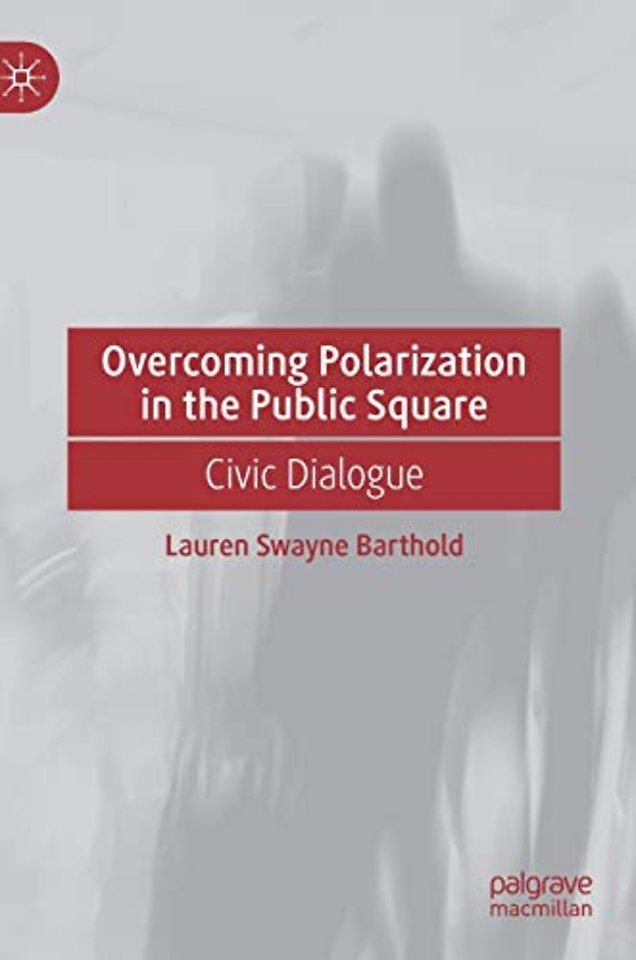
Overcoming Polarization in the Public Square
Civic Dialogue
Samenvatting
This book describes how civic dialogue can serve as an antidote to a polarized public square. It argues that when pervasive polarization renders rational and fact-based argumentation ineffective, we first need to engage in a way that builds trust. Civic dialogue is a form of structured discourse that utilizes first-person narratives in order to promote trust, openness, and mutual understanding. By creating a dialogic structure that encourages listening and reflection, particularities and differences about fraught identities can be expressed in such a way that leads to the possibility of connecting through our fundamental, shared, and deeply felt humanity. Drawing on Plato, Buber, Gadamer, Dewey, cognitive bias research, as well as the work of dialogue practitioners, Lauren Swayne Barthold provides a sustained defense of civic dialogue as an effective strategy for avoiding futile political arguments and for creating pluralistic democratic communities.
Specificaties
Inhoudsopgave
Acknowledgements
1 Introduction 1
2 The Roots of Dialogue 31
3 Understanding (as) Dialogue 65
4 Defining Dialogue 111
5 The Power of Dialogue 167
6 The Virtues of Dialogue 207
Bibliography 247
Index 262
Vaak samen gekocht


Anderen die dit boek kochten, kochten ook
-
 Roger-Pol Droit€ 23,99
 -
H. Houtkoop€ 21,95
-
Dries Van Ingen€ 23,99
-
Rob Tempelaars€ 16,95
-
Byung-Chul Han€ 17,99
-
Valdar Berkenbosch€ 17,50