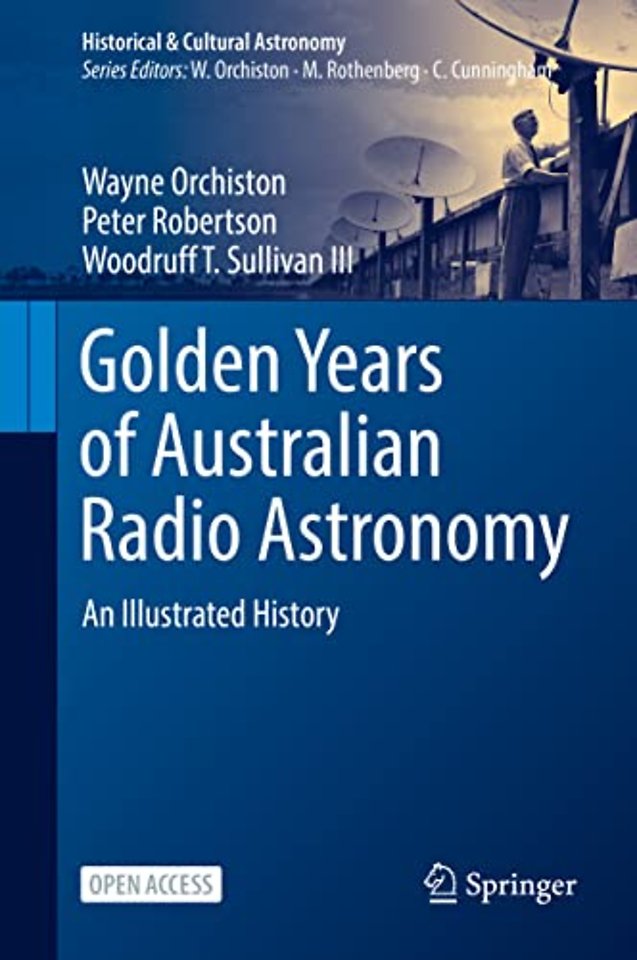
Golden Years of Australian Radio Astronomy
An Illustrated History
Samenvatting
The evolution of Australian radio astronomy from 1945 to 1960 has been studied in detail by numerous historians of science in recent years. This Open Access book is the first to present an overview of this remarkable chapter in Australian science.
The book begins in the post-war period, as the Radiophysics Laboratory in Sydney switched from secret wartime research on radar to peacetime applications of this new technology. Next follows the detection of radio waves from space and the ensuing transformation of this fledgling science into the dominant research program at the Radiophysics Lab. Drawing from this history, the book shows how by 1960 the Radiophysics Lab had become the largest and most successful radio astronomy group in the world. The final chapter presents an overview of Australian radio astronomy from 1960 to the present day, as Australia prepares to co-host the multi-national, multi-billion-dollar Square Kilometre Array.
Nearly 300 high-quality images complement the text, drawn from a wide range of sources including the extensive collection held by the CSIRO Radio Astronomy Image Archive. The book will be an essential reference for readers interested in the scientific and cultural development of radio astronomy.
This book is published open access under a CC BY 4.0 license.
Specificaties
Inhoudsopgave
<p>Preface</p>
<p> </p>
<p>1 Introduction – From Radar to Radio Astronomy</p>
<p>References</p>
<p> </p>
<p>2 Frontier Life at the Field Stations</p>
<p> 2.1 Introduction</p>
<p> 2.2 Dover Heights</p>
<p> 2.3 Georges Heights</p>
<p> 2.4 Hornsby Valley</p>
<p> 2.5 Bankstown Aerodrome</p>
<p> 2.6 Potts Hill</p>
<p> 2.7 Penrith</p>
<p> 2.8 Dapto</p>
2.9 Badgery’s Creek<p></p>
<p> 2.10 Fleurs</p>
<p> 2.11 Murraybank</p>
<p>References</p>
<p> </p>
<p>3 Exploring the Neighbourhood – the Sun, the Moon and Jupiter</p>
<p> 3.1 The Sun</p>
<p> 3.1.1 The first solar observations at Radiophysics</p>
<p> 3.1.2 Solar eclipses and solar bursts</p>
<p> 3.1.3 Classifying solar bursts at Penrith and Dapto</p>
<p> 3.1.4 Studies of the ‘quiet Sun’ at Potts Hill</p>
<p> 3.2 The Moon</p>
<p> 3.3 Jupiter</p>
<p>References</p>
<p> </p>
<p>4 Expanding Horizons – the Milky Way and Beyond</p>
<p> 4.1 Discovery of the First Discrete Radio Sources</p>
<p> 4.2 From Dover Heights to Fleurs</p>
<p> 4.3 Radio Emission from the Galactic Centre</p>
<p> 4.4 Surveys of the Background Radio Emission</p>
<p> 4.5 Distribution of Neutral Hydrogen</p>
<p> 4.6 Radio Emission from Stars</p>
<p>References</p>
<p> </p>
<p>5 Where did it all Lead?</p>
<p> 5.1 Beyond the Doors of Radiophysics</p>
<p> 5.2 Big Science comes to Australia</p>
5.3 Changing of the Guard<p></p>
<p> 5.4 Pulsars – Cosmic Lighthouses at Radio Wavelengths</p>
<p> 5.5 A Birthday Present for the Nation</p>
<p> 5.6 A Radio Telescope as Wide as Australia</p>
<p> 5.7 Simply Astronomical – the Square Kilometre Array</p>
<p>References</p>
<p> </p>
<p>Bibliography on Early Australian Radio Astronomy</p>
<p>About the Authors</p>
<p>Index</p>