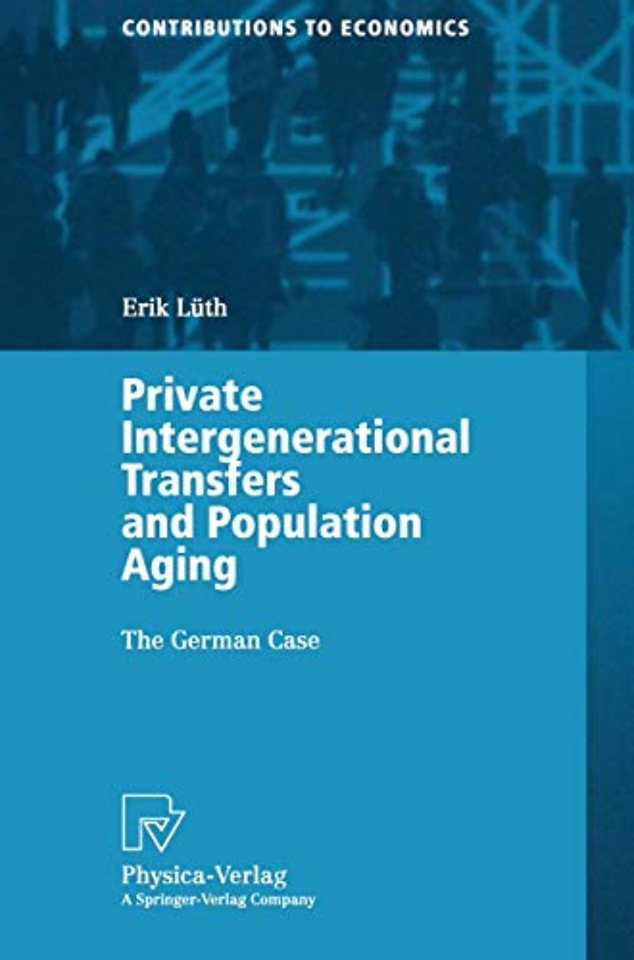
Erik Lüth
Physica-Verlag HD
0e druk, 2001
9783790814026
Private Intergenerational Transfers and Population Aging
The German Case
Specificaties
Paperback, 188 blz.
|
Engels
Physica-Verlag HD |
2001
ISBN13: 9783790814026
Rubricering
Onderdeel van serie
Contributions to Economics
Levertijd ongeveer 9 werkdagen
Gratis verzonden
Samenvatting
In the forthcoming decades the industrialized countries will experience a demographic transition that is unprecedented in history. While the transition's impact on public pension schemes has extensively been examined, its implication for private intergenerational transfers has gone almost unnoticed by the literature. This study attempts to make up for that gap in the literature. It gives a comprehensive overview of private transfer patterns in Germany, extends the methodology of generational accounting to include private intergenerational transfers, and presents a computable general equilibrium model that for the first time allows to analyze various bequest motives in a unified framework.
Specificaties
ISBN13:9783790814026
Taal:Engels
Bindwijze:paperback
Aantal pagina's:188
Uitgever:Physica-Verlag HD
Druk:0
Hoofdrubriek:Economie, Mens en maatschappij
Inhoudsopgave
1. Introduction.- 2 Motives for Private Intergenerational Transfers.- 2.1 Altruistic Transfers.- 2.2 Accidental Bequests.- 2.3 Transfers as Exchange.- 2.4 Transfers for Joy-of-Giving.- 2.5 Empirical Evidence.- 3. Empirical Facts About Transfers in Germany.- 3.1 The Income and Expenditure Survey 1993.- 3.2 The Socio-Economic Panel.- 3.2.1 Transfers Inter Vivos.- 3.2.2 Bequests Between 1960 and 1988.- 3.2.3 Particulars about Wealth Holdings.- 4. Private versus Public Transfers During a Demographic Transition.- 4.1 The Demographic Transition.- 4.2 What Demographics Reveal About Public and Private Transfers.- 4.3 The Impact of the Transfer Motive.- 4.4 A Generational Accounting Approach.- 4.4.1 Conventional Generational Accounting.- 4.4.2 The Extension to Private Transfers.- 4.4.3 Caveats and Conclusion.- 5. Intergenerational Transfers in a General Equilibrium Setting.- 5.1 The Model.- 5.2 Private Transfers, Demographic Transition, and Generational Welfare.- 5.2.1 No Private Transfers.- 5.2.2 Joy-of-Giving.- 5.2.3 Accidental Bequests.- 5.2.4 Bequests-as-Exchange.- 5.2.5 Summary.- 5.3 Intergenerational Transfer Accounting and General Equilibrium.- 5.3.1 Conventional Generational Accounting.- 5.3.2 Extended Generational Accounting.- 5.3.3 Summary.- 5.4 The Taxation of Private Intergenerational Transfers.- 5.4.1 The Impact of Distortionary Social Insurance Contributions.- 5.4.2 Joy-of-Giving.- 5.4.3 Accidental Bequests.- 5.4.4 Bequests-as-Exchange.- 5.4.5 Summary.- 6. Summary.- A. Appendix.- A.1 The Implications of Altruistic Bequests.- A.2 The Impact of Social Security on Accidental Bequests.- A.4 Sensitivity Analysis of Public and Private Accounts.- A.5 The Unified General Equilibrium Model.- A.6 Bequests-as-Exchange and Lump-Sum Taxation.- A.7 The Derivation of Future Generations’ Public Generational Account.- A.8 The Derivation of the Life-Cycle Budget Constraint in Terms of an Average Individual.- A.9 The Calculation of Future Generations’ Total Generational Account.- A.10 The Equivalence of GAt+l,t+1 and TTt+i,t+1 under Steady State Conditions.- A.11 The Equivalence of Extended Generational Accounting and the Back-of-the-Envelope Calculation.- A.12 Complete Simulation Results.- References.
Anderen die dit kochten, kochten ook
-
 Nassim Nicholas Taleb€ 24,99
 -
Brenda de Zeeuw€ 43,95
-
Jonah Berger€ 25,88
-
Paul Schenderling€ 27,50
-
Peter Antonioni€ 29,99
-
Rick Hayes€ 91,99