Over Maarten van Beek
Maarten van Beek writes about work as if it were life - because, in truth, it is. For nearly three decades he has moved through organisations large and small, from factory floors humming with routine to boardrooms echoing with ambition - including ING, Unilever and Mölnlycke. He has served, among other roles, as CHRO and carried global responsibility for branding and communications. Along the way he discovered something unsettling: strategy is rarely the hardest part; behaviour is.
He has lived across five continents, travelling from Geleento Leiden, Beijing, Geneva, Ithaca (NY), London, São Paulo, Singapore, Gothenburg and The Hague He reads people, senses a room, and understands how organisations move and connect.
Maarten teaches, thinks and writes. He has served on boards and supervisory boards including Cordaid, UAF (the NGO for Student Refugees), NPO (Dutch Public Broadcasting), the Dutch Employers’ Association (AWVN), and the International Leadership Association (ILA).
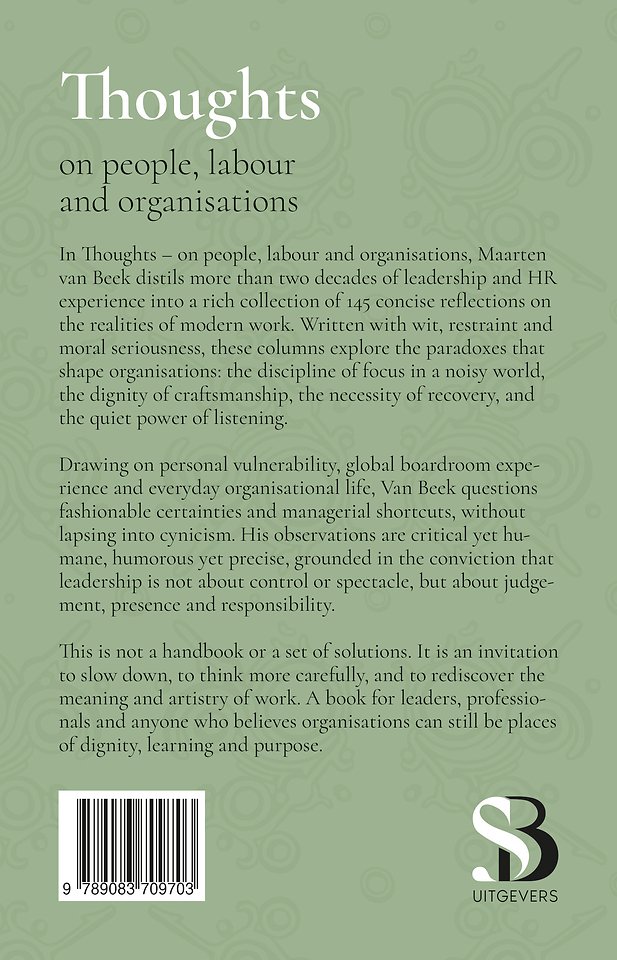
He wrote HR Impact: The Power of Craftsmanship (2020). His columns blend lived experience, research, gentle provocation and a touch of dry humour. He believes sharpness can coexist with kindness, and that reflection often travels further than outrage.
When not writing, he walks through The Hague’s ‘Zeeheldenkwartier’, studies art with patient curiosity, cooks for friends, or retreats to his wine cellar — where conversations slow, certainty softens, and honesty, like good wine, improves with age.