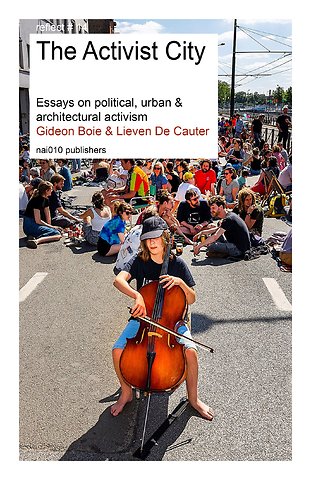
The Activist City
Essays on Political, Urban and Architectural Activism
Samenvatting
Surprising perspective on the state of activism in the urban domain
Inspiring plea for activism as a form of ‘bottom-up’ democracy
The Activist City highlights different forms of civic protest: political, urban and architectural activism. Political activism mostly takes place in the city, urban activism has the city as its topic. ‘Architectural activism’ sounds like a paradox as architecture is on the side of money and power and activism opposes these. But over the last years we have seen architects engaging with the skills of their discipline within urban activism and even see forms arising of what could be called ‘activist architecture’.
The first part of this book evokes in several essays the broad context of activism today, with a focus on ecology and the commons. The second part contains an introduction to the idea of activism as democracy in the city, focussing on the three different shapes it takes. The final part reconstructs the struggle for road safety in Brussels (a constant reference point in the book) as a situated commitment spanning over years as well as a concrete form of urban activism.
The authors, who have been teaching and writing together for years on these topics, consider activism as an important element in bottom-up urban democracy and the struggle for a more social, just and sustainable society.
Gideon Boie is an architect and philosopher, teaching at the department of architecture of KU Leuven, Campus Brussels. Discursive Architecture is his latest book in English.
Lieven De Cauter is a philosopher and art historian, who has been teaching in several institutions (PARTS, Berlage Institute, RITCS), and is now retired from the same university. Ending the Anthropocene is his latest book in English. Both authors work and live in Brussels.
Specificaties
Inhoudsopgave
(Lieven De Cauter)
1. The Positive Power of Protest
(Activism Explained to Young People) 14
2. The Four Fundamental Conceptions of the Commons 24
3. On the Elusive Nature of the Urban Commons 32
4. A Small Theology of Civil Disobedience 40
5. Language and Power 50
6. Final Thoughts on Art and Politics 56
7. The Toxic Magic of the ‘Congo Style’ 62
8. Stories for the End of the World 70
9. Farewell to the Anthropocene 82
II Forms and Constellations of Activism
(Gideon Boie & Lieven De Cauter)
Forms of Activism as Democracy in the City.
An Introduction for Young Architects
1. What is Activism? 99
2. Political Activism 103
3. Urban Activism 112
4. Architectural Activism 132
5. Activist Architecture 146
Three Space-Time Constellations of Urban and
Architectural Activism in Brussels
Introduction
1. The North Quarter and the Modernist Tabula Rasa 165
2. The Bourse and the Right to Centrality 173
3. Tour & Taxis and the Possibilities of Temporary Occupation 185
4. Postscript on Activist Institutions 190
5. Prolegomena to a ‘Metabletics of Activism’ 194
III The Struggle for Road Safety. The Case of Brussels
(Gideon Boie)
Introduction
1. Five Seconds for a Child’s Life 203
2. Civil Obedience in Road Safety Activism 207
3. You Can’t Solve Road Rage with a Lick of Paint 211
4. Participation Is Not a Technical Detail 215
5. Redistribution of Public Space Is Good for Public Health 220
6. Resistance Comes from Within 224
7. A Hopscotch Is Not a Parking Space 228
8. Car Envy in the Climate Regime 232
9. The Epistemological Delirium of Road Safety Deniers 236
10. The Right to the Street 241
11. The Cleaning Lady Also Likes Bionade 246
12. First Give Me Back My Bike (Epilogue) 251
Acknowledgements 254
Origin of the Texts 260