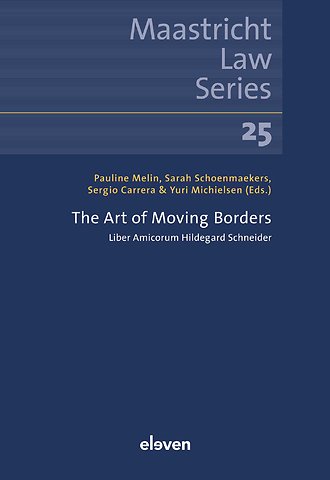
The Art of Moving Borders
Liber Amicorum Hildegard Schneider
Samenvatting
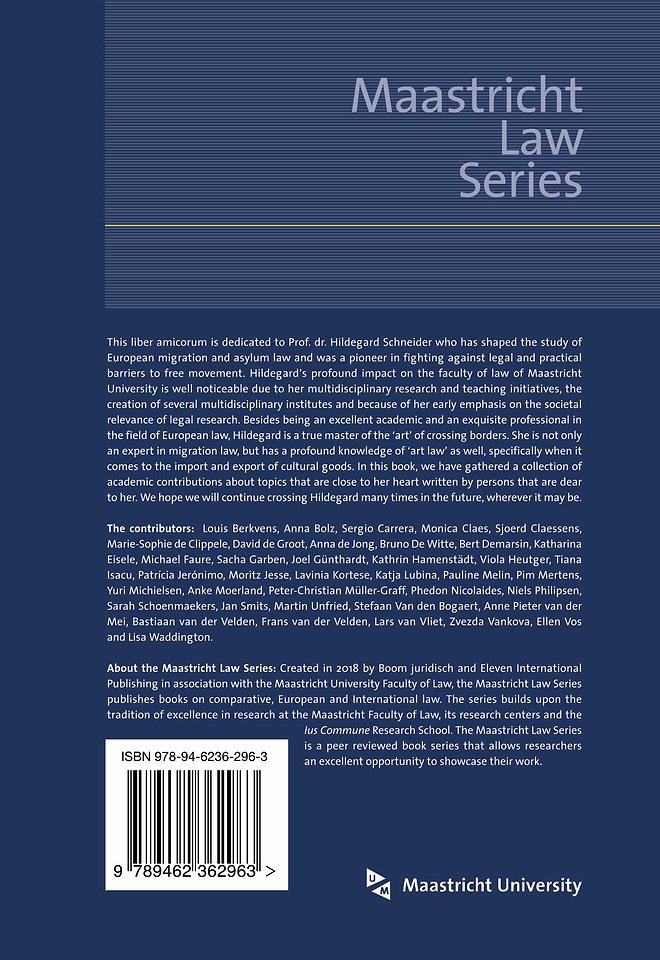
This liber amicorum is dedicated to Prof. dr. Hildegard Schneider who has shaped the study of European migration and asylum law and was a pioneer in fighting against legal and practical barriers to free movement.
Hildegard’s profound impact on the faculty of law of Maastricht University is well noticeable due to her multidisciplinary research and teaching initiatives, the creation of several multidisciplinary institutes and because of her early emphasis on the societal relevance of legal research. Besides being an excellent academic and an exquisite professional in the field of European law, Hildegard is a true master of the ‘art’ of crossing borders. She is not only an expert in migration law, but has a profound knowledge of ‘art law’ as well, specifically when it comes to the import and export of cultural goods. In this book, we have gathered a collection of academic contributions about topics that are close to her heart written by persons that are dear to her. We hope we will continue crossing Hildegard many times in the future, wherever it may be.
The contributors: Louis Berkvens, Anna Bolz, Sergio Carrera, Monica Claes, Sjoerd Claessens, Marie-Sophie de Clippele, David de Groot, Anna de Jong, Bruno De Witte, Bert Demarsin, Katharina Eisele, Michael Faure, Sacha Garben, Joel Günthardt, Kathrin Hamenstädt, Viola Heutger, Tiana Isacu, Patrícia Jerónimo, Moritz Jesse, Lavinia Kortese, Katja Lubina, Pauline Melin, Pim Mertens, Yuri Michielsen, Anke Moerland, Peter-Christian Müller-Graff, Phedon Nicolaides, Niels Philipsen, Sarah Schoenmaekers, Jan Smits, Martin Unfried, Stefaan Van den Bogaert, Anne Pieter van der Mei, Bastiaan van der Velden, Frans van der Velden, Lars van Vliet, Zvezda Vankova, Ellen Vos and Lisa Waddington.
About the Maastricht Law Series: Created in 2018 by Boom juridisch and Eleven International Publishing in association with the Maastricht University Faculty of Law, the Maastricht Law Series publishes books on comparative, European and International law. The series builds upon the tradition of excellence in research at the Maastricht Faculty of Law, its research centers and the Ius Commune Research School. The Maastricht Law Series is a peer reviewed book series that allows researchers an excellent opportunity to showcase their work.
Trefwoorden
Specificaties
Inhoudsopgave
Monica Claes & Ellen Vos
The Manifold Manifestations of EU Competence – Positive and Negative, Hard and Soft, Internal and External 9
Sacha Garben
Unseen Positive Obligations for the Member States – From Free Movement to the Charter of Rights 31
Bruno De Witte
COVID-19 and the Quest for a Stronger European Health Union 43
Anne Pieter van der Mei & Lisa Waddington
Towards a FairEULabour Migration Policy – From Tampere to Lisbon – From Lisbon to the Pact, and Back to Maastricht 59
Sergio Carrera, Katharina Eisele, Pauline Melin & Zvezda Vankova
The Future of Free Movement – The Single European Population Register 87
David de Groot & Tania Isacu
EU rechtsbescherming voor amateursporters in TopFit 99
Stefaan Van den Bogaert & Katja Lubina
The Evolution of the Principle of Partial Access Under the Professional Qualifications Directive – Pitfalls and Possibilities 117
Lavinia Kortese
The Failure of the Draft Institutional Framework Between Switzerland and the EU – Options for Future EU-Swiss Relations 135
Joel Günthardt
Crisis? What Crisis? 159
Martin Unfried & Pim Mertens
Free Movement of Persons in Times of COVID-19 – A Report about Family Visits in the Summer of 2021 173
Moritz Jesse
Mobility and Rights in the Portuguese-Speaking World – A Lusophone Citizenship in Bits and Pieces 187
Patrícia Jerónimo
Legal Othering and the UK’s Hostile Environment Policy 227
Kathrin Hamenstädt
The Perception of Climate Change Migrants 243
Michael Faure
European Economic Law in the Pandemic Crisis 261
Peter-Christian Müller-Graff
Ne bis in idem in EU Competition Law: Why the ECJ Had to Overrule Toshiba in bpost and Nordzucker 271
Wouter Devroe
Exempting Green Cartels from Competition Law? – Competition versus Regulation in Times of Sustainability 309
Niels J. Philipsen
The Use of Languages in Public Procurement Procedures – A Hidden Non-Tariff Barrier to Free Movement? 323
Sarah Schoenmaekers
The Dispute-Settlement Provisions of the EU-UK Trade and Cooperation Agreement – Are They Capable of Resolving Disputes Effectively? 341
Phedon Nicolaides
Moot Court Competitions in Legal Curricula – Lessons from
Archaeology? 361
Sjoerd J.F.J. Claessens
Johann Stephan Pütter (1725-1807) en de ‘Limburgse’ rechtsgeschiedenis – Drie responsa in zake van Victoria Hedwig Caroline von Anhalt, markiezin de Favras contra vorst Carl Ludwig von Anhalt Schaumburg 369
Louis Berkvens
Lost Art Registers 389
Lars van Vliet
Restitutie van koloniaal erfgoed – Forever young, of terug van nooit echt weggeweest 403
Bert Demarsin & Marie-Sophie de Clippele
Tera di famia: collectively owned family land, private law in the Dutch Caribbean and the convention on the value of cultural heritage for society 423
Bastiaan D. van der Velden & Viola Heutger
Art and Law in Islam 439
Frans van der Velden
Regels & Romantiek – over wetten en juristen in de wereld van Jane Austen 457
Anna M. de Jong
Copyright Implications of Digitizing Cultural Heritage 475
Anke Moerland
The Rise of NFTS in the Art World – A Vehicle for Generational Progress or a New Gold Rush? 503
Anna Bolz
Is er een recht om te feesten? Een discursieve bijdrage 515
Jan Smits
About the Authors 527
Anderen die dit e-book kochten, kochten ook
-
 W.J.M. van Veen€ 131,00
 -
Mariette Lokin€ 93,95
-
Arnoud Engelfriet€ 99,00
-
Jac Hijma€ 62,00
-
Simon Cornielje€ 57,50
-
Ton Hartlief€ 73,00